D-0126440-A – 2020/08
VisualEyes™ 515/525 Instructions for Use - US Page 27
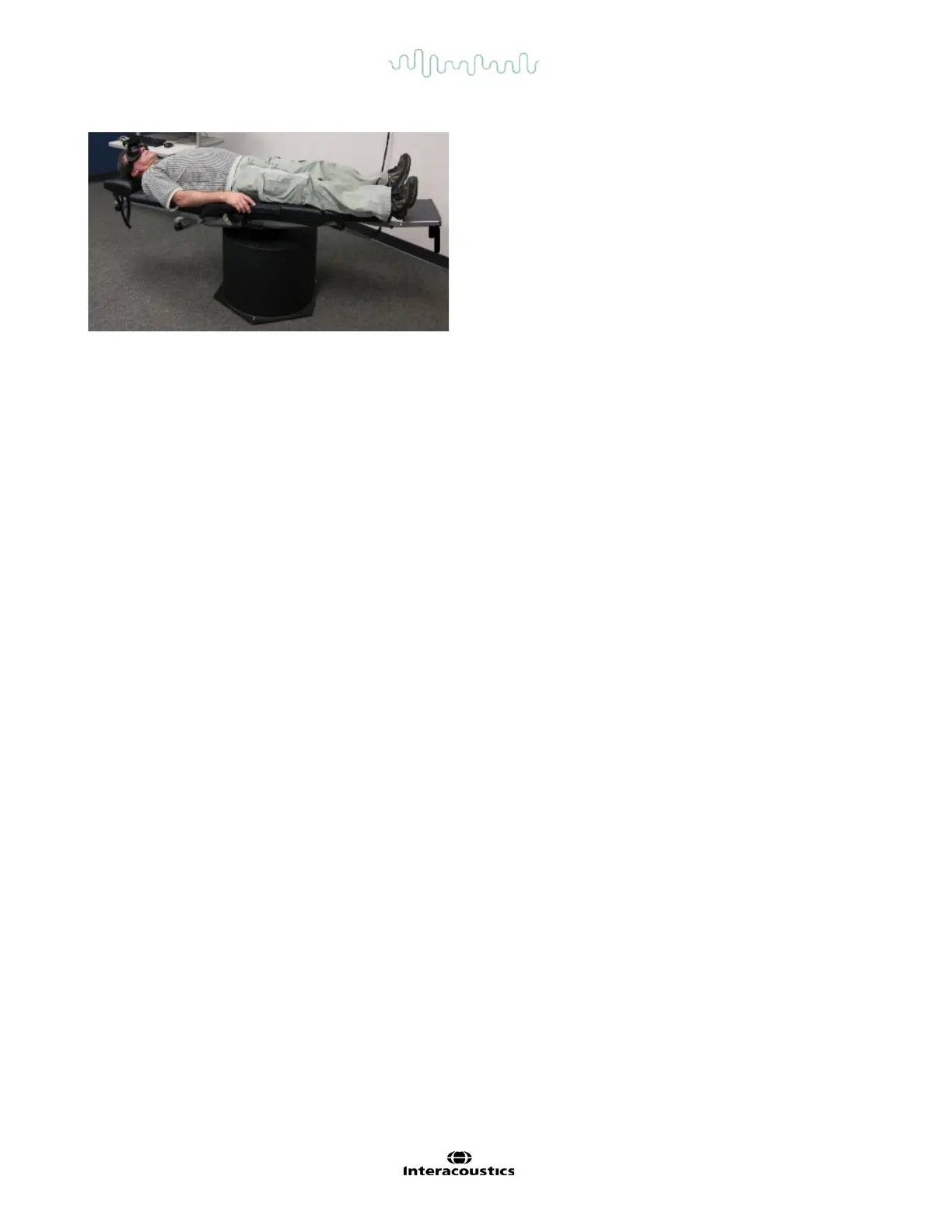
Figure 4.7-2 Supine positional test.
4.7.6 Oculomotor tests
The oculomotor tests include Gaze, Smooth Pursuit, Random saccade, Saccadometry, and Optokinetic tests.
These tests are performed with the goggle cover removed so that the patient can follow targets as they move
around on the TV, projector screen, or with the laser projected on the booth enclosure wall. During Gaze
tests, the patient will fixate on stationary targets that are positioned at center, right, left, up and down.
Random Saccade tests allow the target to move randomly in a horizontal, vertical or mixed pattern while the
patient follows the target with his/her eyes. Smooth Pursuit tests the patient’s ability to track a target that
moves in a sinusoidal pattern across the screen. The target speed will increase from 0.1 Hz to 0.5 Hz in 0.1
Hz steps. The Optokinetic test is used to examine eye movements during stimulation from a large moving
checkerboard pattern or stripe pattern produced by the OKN drum along the booth wall. All oculomotor tests
will display real-time graphical data to help the clinician interpret the results for each individual test.
4.7.7 Active Head Rotation
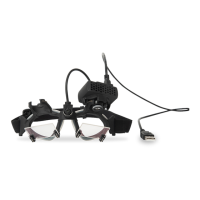
Ensure the chair is in the sitting position and locked. If applicable, leave the hook and loop straps (Orion and
System 2000) from the head support detached from the goggles. Attach the VORTEQ
TM
IMU or VORTEQ
TM
rate sensor to the binocular goggles. If using the VORTEQ
TM
rate sensor, make sure the sensor is manually
fixed in the correct orientation for testing. The start of the test will have the patient shake his/her head to the
sound of a metronome at the low frequency of the test for ten seconds as practice then the test will begin.
Have the patient smoothly shake his/her head side to side for horizontal testing or up and down for vertical
testing. If the test is performed with a wrong orientation, the operator gets a warning message from the
software.
4.7.8 Dynamic Visual Acuity
This test does not require any goggle. Ensure the chair is in the sitting position and locked. Attach the
VORTEQ
TM
IMU or VORTEQ
TM
rate sensor to the DVA headband. Before starting the test, the patient will
establish his/her static acuity by correctly defining the C character without shaking the head. The test will then
proceed with testing each direction while the patient shakes his/her head to the sound of a metronome. Have
the patient smoothly shake his/her head side to side for horizontal testing or up and down for vertical testing.
If the test is performed with a wrong orientation of the VORTEQ
TM
rate sensor, the operator gets a warning
message from the software.






 To Next Page