Need help?
Do you have a question about the JPS ACU-5000 and is the answer not in the manual?
Provides a description, specifications, and configuration and operating instructions for the ACU-5000.
Details the ACU-5000's twelve communications channels and local handset channel for patching and interoperability.
Explains channel activation options, minimum/maximum channels, and activation key codes.
Describes the RJ-45, RJ-11, RJ-12, and USB ports used for connecting various devices and networks.
Outlines the maximum number of channels and specific limitations for PSTN port configuration.
Details the RJ-45 Ethernet connectors used for IP network connections and remote control.
Describes the provided handset with PTT switch for setup and local operation.
Explains the internal speaker and external speaker jack for local audio monitoring.
Covers headphone and microphone jacks available on rack mount versions for audio output and input.
Outlines the two-step process of configuring channels via the web-based GUI.
Explains the two methods for controlling the unit: web-based GUI and DTMF sequences.
Describes how to connect two units for a 24-channel expanded system.
Details inter-operation with other ACU-5000 units and radio gateways using the BSI protocol.
States that the manual does not cover SIP fundamentals, directing users to other resources.
Refers the user to Section 10 for information on new features and updates.
Provides detailed technical specifications for the ACU-5000 hardware and interfaces.
Lists the items included in the ACU-5000 shipping levels for tabletop and rack mount versions.
Lists optional equipment that is not included with the ACU-5000 unit.
Provides instructions for unpacking, inspection, and general installation procedures.
Details environmental requirements, placement, and airflow for proper unit installation.
Explains the unit's power requirements and the included external power supply.
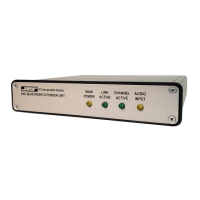
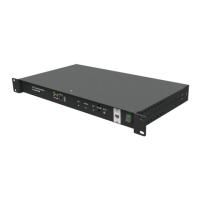
Describes the physical dimensions and form factor of the tabletop and rack mount versions.
Details the front and rear panel connectors, controls, and status indicator LEDs.
Highlights critical safety warnings and procedures related to electrical and telephone line connections.
States that no user-serviceable internal components exist and outlines basic upkeep requirements.
Introduces the ACU-5000's external communication interfaces: Radio, VoIP, RoIP, and PSTN.
Explains the physical RJ-45 connectors for radio and four-wire device connections.
Details how VoIP connections are made via Ethernet ports using the SIP protocol.
Describes the RoIP protocol for optimizing VoIP in radio environments, used with JPS devices.
Explains the use of RJ-11 connectors for PSTN connections to telephone systems.
Describes the initial login process using the unit's IP address, username, and password.
Provides an overview of the system configuration options accessible via the web GUI.
Details settings for IP address, subnet mask, gateway, and DNS servers.
Explains how to configure the system for a 24-channel expanded setup with a primary/secondary unit.
Covers creating, modifying, and deleting user accounts and assigning roles and permissions.
Details how to manage PIN numbers for secure access to system features via DTMF.
Explains how to upload and apply software updates to add features or fix behaviors.
Describes how to update license keys to enable or increase the number of system channels.
Outlines the process for resetting the unit's configuration to factory default settings.
Provides instructions for gracefully shutting down or restarting the ACU-5000 via software control.
Introduces the ACU-5000's channel configuration options and interface.
Lists and describes available channel types: Radio, SIP, PSTN, RoIP, and Disabled.
Details the initial selection of channel type and other fundamental settings for all channel types.
Explains how to view and interpret the current status information for each channel.
Covers configuration settings specific to the handset channel (channel 0).
Details configuration options for radio channels, including COR types and DTMF detection.
Describes PSTN channel settings, including dialing, answering, and call termination options.
Outlines the numerous SIP-specific configuration options for VoIP connections.
Explains RoIP channel configuration for optimizing VoIP in radio environments.
Describes Observe Mode for system setup and optimization, providing instantaneous status indications.
Lists available preferences and provides brief descriptions of each category.
Allows customization of Net Control GUI behavior for individual users.
Configures standard behaviors like confirmation prompts and double-click actions.
Defines how the system responds to sequential channel clicks in different scenarios.
Enables users to change their individual login passwords.
Sets preferences for retaining system configurations across power cycles and logins.
Configures DTMF behaviors, including speed dials and PIN security.
Allows setting up two-digit shortcuts for dialing phone numbers and IP addresses.
Provides tools for creating, editing, importing, and exporting channel configuration profiles.
Explains the context-sensitive help features and how to access the help utility.
Describes control and configuration via a PC connected to the unit over an IP network.
Explains how to use DTMF signaling to create and break interconnections with channels.
Details how to restore the unit to its initial default state via a system menu item.
Explains how to use the recessed reset switch to read the IP address or reset defaults.
Covers operational procedures performed via the web browser interface.
Shows the Net Control GUI with channels in the 'Free' net before any cross-patches.
Explains connecting channels to nets and disconnecting them.
Details how to initiate outgoing connections for PSTN, SIP, and RoIP channels.
Describes how to answer incoming calls indicated by a yellow status icon.
Explains how to set up a channel to monitor audio from other channels.
Describes how to make temporary connections between individual modules not in the same net.
Details the use of the 'Remove' button for breaking Priority and Monitor Connections.
Explains how to create temporary Net Groups by combining existing nets.
Covers additional operations like Disband, Connect All, Revert, and Disband All.
Explains how to quickly disconnect an entire net.
Describes creating a single net with all appropriate channels.
Details how to mark and revert to previous connection states.
Explains how to disconnect all channels and move them to the Free Row.
Describes operation of an expanded system with more channels and nets.
Explains how to view live status indicators on channel icons and in status boxes.
Interprets the small indicator icons in channel icons to show channel state.
Explains how to modify Net Control operations using user-specific preferences.
Details how to control the ACU-5000 using DTMF from radios, telephones, or VoIP phones.
Lists and explains updates and new features not yet fully integrated into the manual text.

 To Next Page
 General