9
Your RS300 receiver is equipped with Battery Eliminator
Circuitry (BEC). The receiver gets its power from the
model’s Ni-Cd battery pack, thus saving the weight of an
additional receiver battery. Ni-Cd batteries from 4.8–8.4V
(4–7 cells) can be used safely. Higher voltage packs may
damage the receiver and servos.
Note: When using a separate receiver Ni-Cd as a
power source, the operating voltage range is
4.8–6.0V (4- to 5-cell).
Attention: Make sure the male and female connectors
have the correct polarity (+/-) before connecting. The servo
lead and receiver case are molded so that the lead can only
be inserted correctly. Be sure to orient the servo plug cor-
rectly for proper insertion.
You may use a separate receiver battery to power the
receiver (such as for some electric boats or in gas-powered
vehicles). A Ni-Cd pack plugged into the battery socket on
your receiver will operate your receiver. You can also use
alkaline batteries with the included battery box.
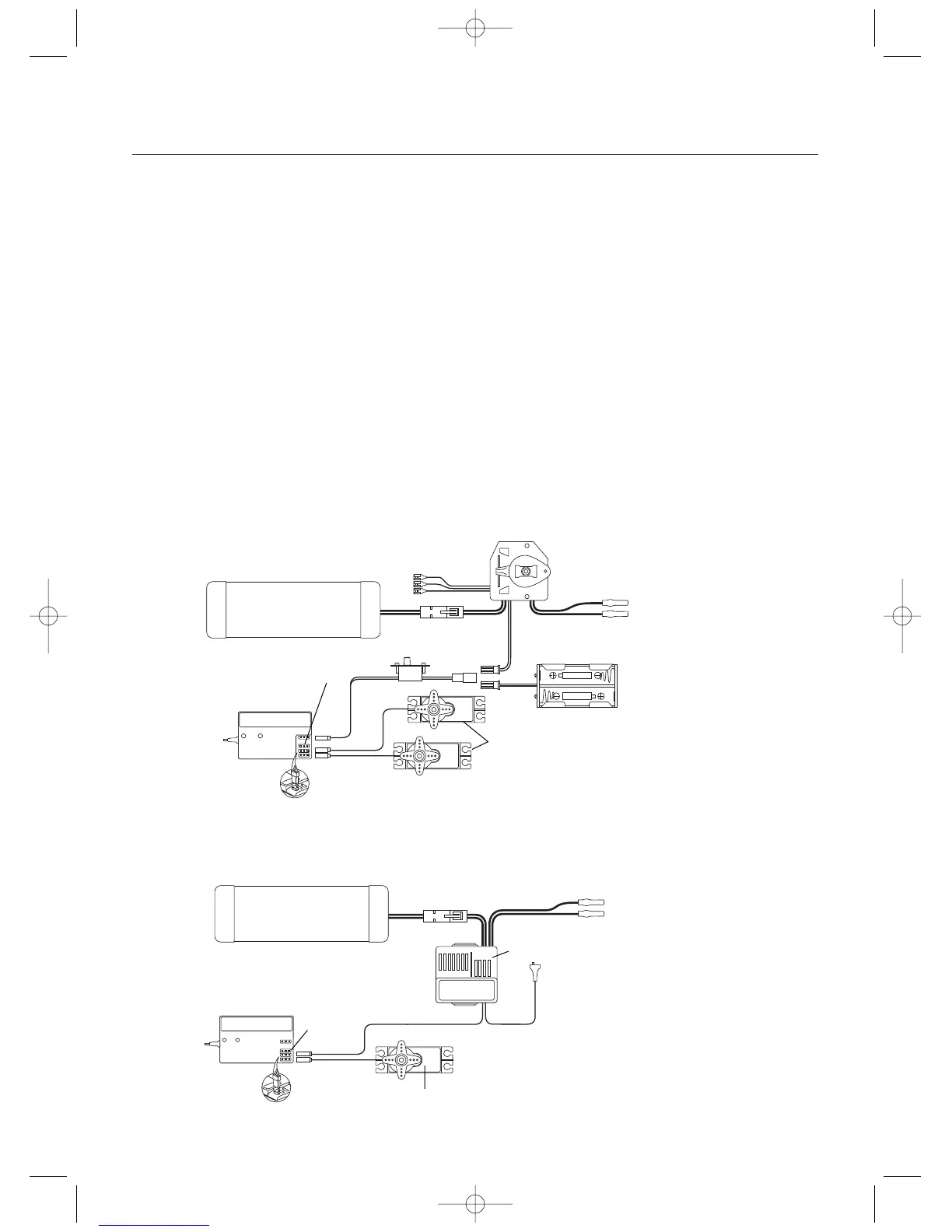
If you use a mechanical speed controller, please make sure
it has the correct connector for a BEC system (red connec-
tor). See Figure A below for a typical setup. Most electronic
speed controllers are set up for BEC operation and plug
directly into your receiver (Figure B). See Figure B for a
typical setup and check your speed controller‘s manual for
correct installation.
Receiver/ Servo Connections and Installation
Figure A – Connections to BEC receiver with mechanical speed controller. Ni-Cd battery and speed controller
are not included in the radio set.
Figure B – Connections to BEC receiver with electronic speed controller. Ni-Cd battery and speed controller
are not included in the radio set.
To Resistors
Mechanical
Speed Control
BEC Connector
Switch
RS300 Receiver
RS300
Z270/Z590M Servos
To Motor
Battery Box
(for use with optional separate
receiver battery power)
7.2V–8.4V Battery
7.2–8.4V Battery
RS300 Receiver
Third Channel
(Optional)
RS300
Z270/Z590M Servo
ESC
To Motor
Third Channel
(Optional)


 To Next Page