Operation of the Rotary Harvesting Unit
OUCC002,0002662 1911APR071/1
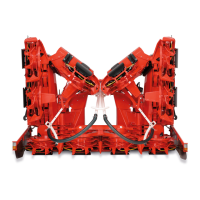
Harvesting Unit Method of Operation
ZX1040573 —UN—12APR07
A—Gathering drum
B—Intake bars
C—Row of teeth
D—Lengthwise direction of crop
E—Feed drums
F— Feed teeth
G—Cross feed drums
H—Guides and scrapers
I— Feed teeth
K—Rotating blade
The harvesting unit is basically to be operated in corn
crop. Nevertheless, due to its capabilities, the harvesting
unit is able to harvest wholecrop silage, alfalfa, rape, field
beans, millet, sunflowers and other stalktype plants.
The cutting system allows the crop to be harvested
from any direction. It does not matter how the row is
approached — it can be approached endon, at right
angles or at an oblique angle if so desired.
None of the stalks can escape the area covered by the
rotary cutter. Although no counterknife is used, the fast
rotating blades (K) cut all the stalks within the unit’s
operating width. The slowly rotating gathering drums (A)
pass the stalks along the intake bars (B). The stalk is
seized by the row of teeth (C) as if by a gripper.
The forward motion of the gathering drums (A) forces
the crop against the feed teeth (I) and so the stalks are
conveyed along the guides and scrapers (H) to the feed
drum (E). The cross feed drums (G) force the stalks
coming from left and right end sections to pass behind the
gathering drums (A). Here the stalks come into contact
with the feed teeth (F).
From there, the stalks are transported in a constant
and compacted stream in direction (D) to the forage
harvester’s feed roll.
301
040810
PN=53



 To Next Page