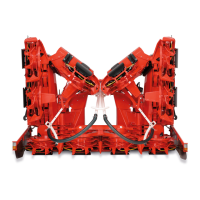
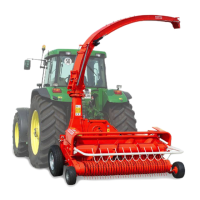
Operation of the Rotary Harvesting Unit
ZX,688RHU009795 1901NOV971/1
OUCC002,00027D8 1917SEP071/1
KM00321,000027D 1919FEB101/1
Harvesting Unit Method of Operation—Higher
Yields Through Narrow Corn Row Spacing
Higher yields are achieved by increasing the number of
plants per surface unit.
The principle of this method is not to double rows, but to
reduce usual row spacing of 75 cm (30 in.) to 30 cm (12
in.). With equal seed density (10 plants/m
2
) plant spacing
within the row can be increased.
Advantages of the method:
•
The individual plants are more effectively placed.
•
Faster shading of the soil as a result of the smaller row
spacing.
•
Reduction of erosion effect.
•
Better utilization of nitrogen contained in the soil.
•
Yields increased by approx. 1217%.
•
Higher quality.
Operating the Harvesting Unit—General Use
Starting the forage harvester
Starting up the forage harvester, switching on the
cutterhead and harvesting unit as well as reversing the
feed rolls should always take place with the engine
running at idle speed (see forage harvester Operator’s
Manual for details).
Engage forward gear at idling speed only. This avoids
unnecessary wear on the clutches.
Reversing the harvesting unit
If a blockage occurs, stop the harvester and reverse
feed rolls, thus bringing the rotary cutters to a standstill.
Blockage must be cleared by hand!
CAUTION: When clearing a blockage by hand,
first shut off the engine, remove the ignition key
from the key switch and wait until all rotating
components have come to a complete standstill.
To avoid injury or death to a bystander, press
the quickstop switch to stop the blades.
Operating the harvesting unit
Maximum operating speed in the fields is 15 km/h (9.32
mph) on 360 and 375 and 20 km/h (12.42 mph) on 330
and 345 harvesting unit.
For headland turns, maintain the rate of rotation. This
avoids unnecessary wear on the harvesting unit drive.
When changing forage wagon, keep the harvesting
unit engaged. This avoids unnecessary wear on the
harvesting unit drive.
Corn Harvesting Normal Harvesting
Conditions
Once the cutterhead knives are rotating at the correct
speed, and the gathering drums have obtained the
relevant speed (40 to 44 rpm), drive into the standing crop.
Ground speed depends on crop density, crop type and
performance of the forage harvester. The shorter the crop
and the lower the crop density, the faster the operator
should drive to ensure satisfactory operation of the feed
elements.
ZX012947 —UN—17APR98
302
040810
PN=54



 To Next Page