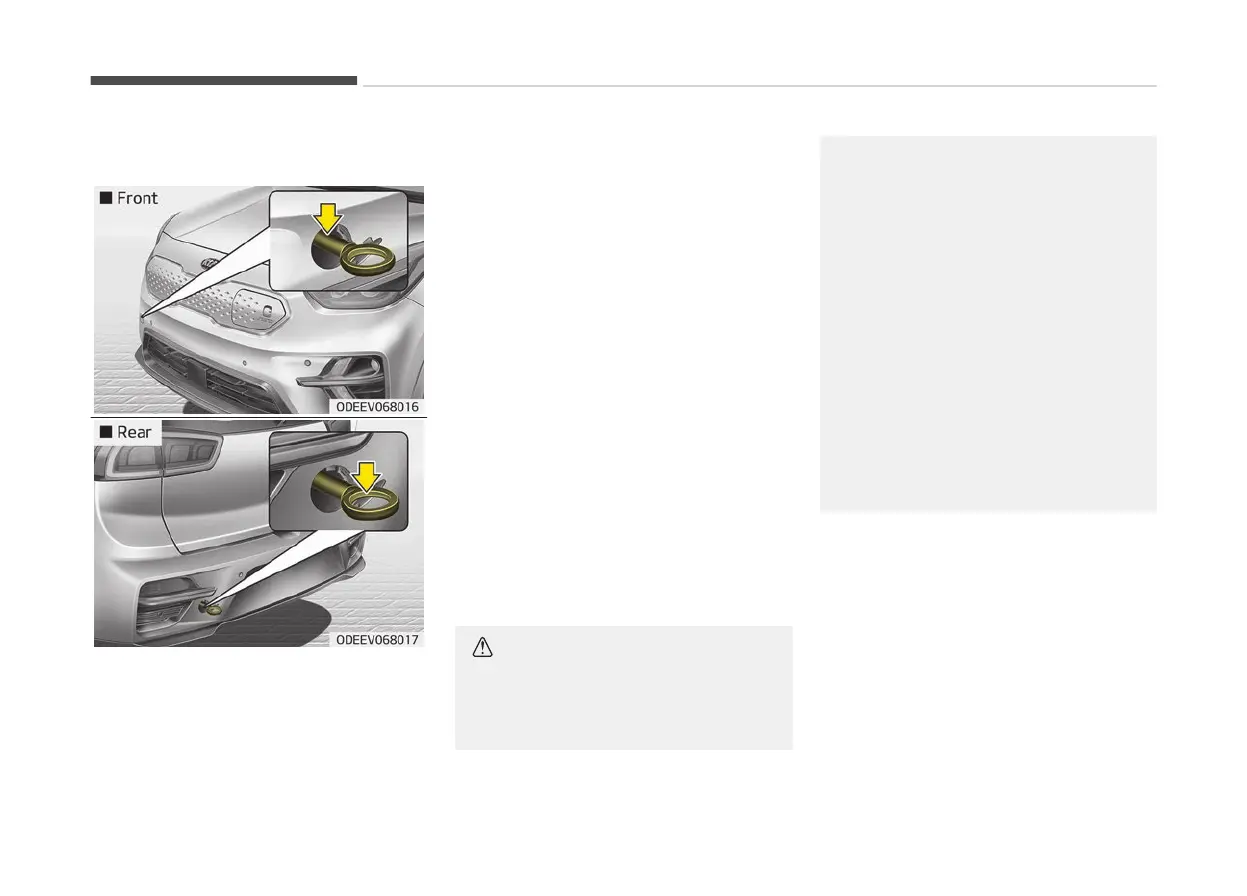
Emergency towing
If towing is necessary, we recommend
you
to have it done by an authorized
Kia dealer or a commercial tow truck
service.
If towing service is not available in an
emer
gency, your vehicle may be tem‐
porarily towed using a cable or chain
secured to the emergency towing hook
under the front (or rear) of the vehicle.
Use extreme caution when towing the
vehicle. A driver must be in the vehicle
to steer it and operate the brakes.
Towing in this manner may be done on‐
ly on hard-surfaced roads for a short
distance and at low speed. Also, the
wheels, axles, power train, steering and
brakes must all be in good condition.
• Do not use the tow hooks to pull a
vehicle out of mud, sand or other
conditions from which the vehicle
cannot be driven out under its own
power.
• Avoid towing a vehicle heavier than
the vehicle doing the towing.
• The drivers of both vehicles should
communicate with each other fre‐
quently.
CAUTION
- Attach a towing strap to the tow
hook.
(Continued)
(Continued)
- Using a portion of the vehicle
other
than the tow hooks for
towing may damage the body of
your vehicle.
- Use only a cable or chain specifi‐
cally
intended for use in towing
vehicles. Securely fasten the ca‐
ble or chain to the towing hook
provided.
- Accelerate or decelerate the ve‐
hicle
in a slow and gradual man‐
ner while maintaining tension on
the tow rope or chain to start or
drive the vehicle, otherwise tow
hooks and the vehicle may be
damaged.
• Befor
e emergency towing, check if
the hook is not broken or damaged.
• Fasten the towing cable or chain se‐
curely to the hook.
• Do not jerk the hook. Apply it steadily
and with even force.
• To avoid damaging the hook, do not
pull from the side or at a vertical an‐
gle. Always pull straight ahead.
What to do in an emergency
7-22



 To Next Page