5 Maintenance
Troubleshooting
to start the truck. The following must be taken
into consideration when doing this:
•
Both batteries must have the same nominal
voltage.
•
The capacity (Ah) of the current-giving bat-
tery must not be significantly lower than the
capacity of the discharged battery.
•
Use a jumper cable with a suffici
ent cross-
section and insulated pole clip
s.
WARNING
A discharged battery can freeze at temperatures
below 0°C. There is then a risk of explosion.
Before connecting the jumper cable, it is essential
that a frozen battery is thawed.
¾ Switch off all current consumers (heater, air
conditioning, lighting).
¾ Open the engine bonnet.
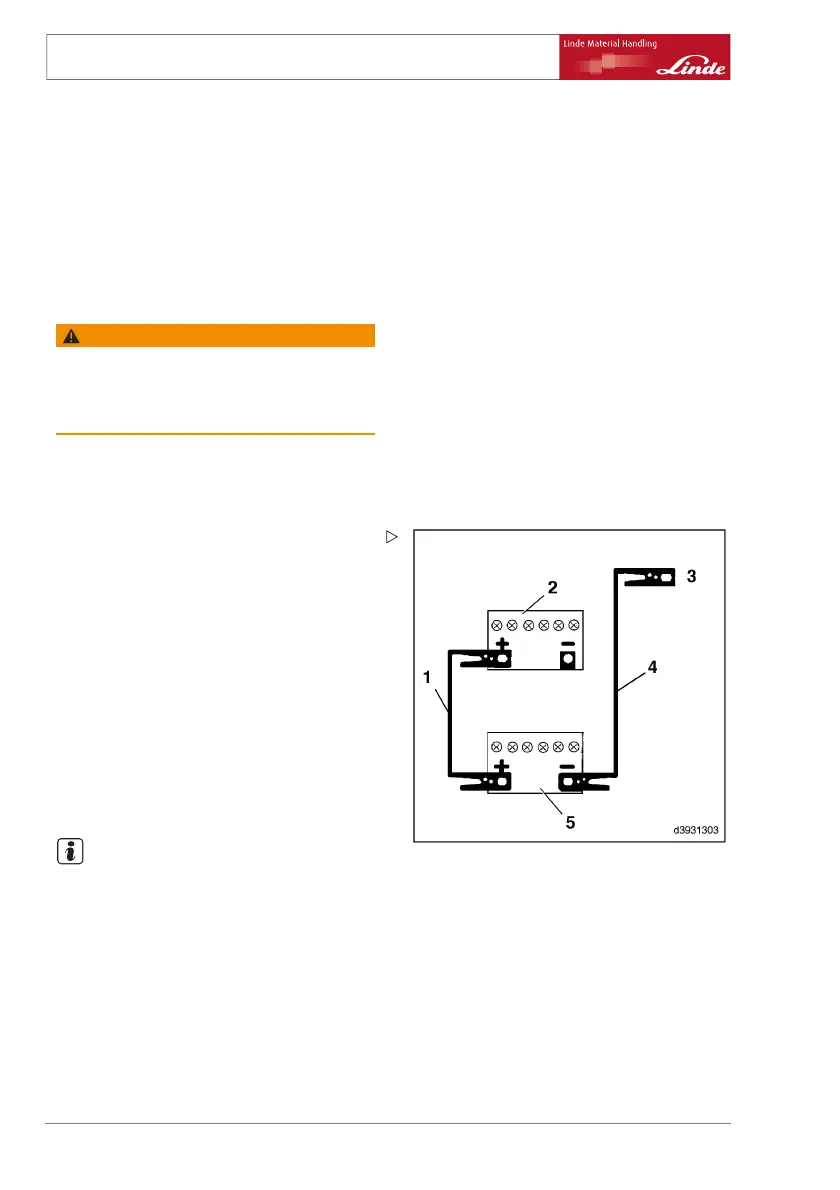
¾ Connect one end of the positive cable (1) to
the positive terminal (+) of the discharged
truck battery (2).
¾ Connect the other end of the positive cable
(1) to the positive terminal (+) of the current-
giving battery (5).
¾ Connect one end of the negative cable (4)
to the negative terminal (-) of the current-
giving battery (5).
¾ Connect the other end of the negative cable
(4) as far away as possible from the dis-
charged truck battery (2) to a massive metal
component securely connected to the en-
gine block or to the engine block itself (3).
NOTE
If the jump-start battery is housed in another
vehicle, start the vehicle’s engine and allow to
idle.
¾ Start the engine.
If the engine does not start straightaway, stop
the starting process after 10 seconds and try
again after around 30 seconds.
¾ Once the engine is running, first disconnect
the negative cable (4) from the engine block
188 Operating Instructions – 393 807 1001 EN – 08/2008



 To Next Page