44
57-606 ECLIPSE Model 706 Guided Wave Radar Transmitter
In the ECLIPSE transmitter, a waveguide with a characteristic
impedance in air is used as a probe. When part of the probe
is immersed in a material other than air, there is lower
impedance due to the fact that a liquid will have a higher
dielectric constant than air. When an EM pulse is sent
down the probe and meets the dielectric discontinuity that
occurs at the air/liquid surface, a reflection is generated.
3.2.3 Equivalent Time Sampling (ETS)
ETS (Equivalent Time Sampling) is used to measure the
high speed, low power EM energy. ETS is a critical key in
the application of TDR to vessel level measurement tech-
nology. The high speed EM energy (1000 ft/s) is difficult to
measure over short distances and at the resolution required
in the process industry. ETS captures the EM signals in real
time (nanoseconds) and reconstructs them in equivalent
time (milliseconds), which is much easier to measure with
today’s technology.
ETS is accomplished by scanning the waveguide to collect
thousands of samples. Approximately 5 scans are taken per
second; each scan gathers more than 50,000 samples.
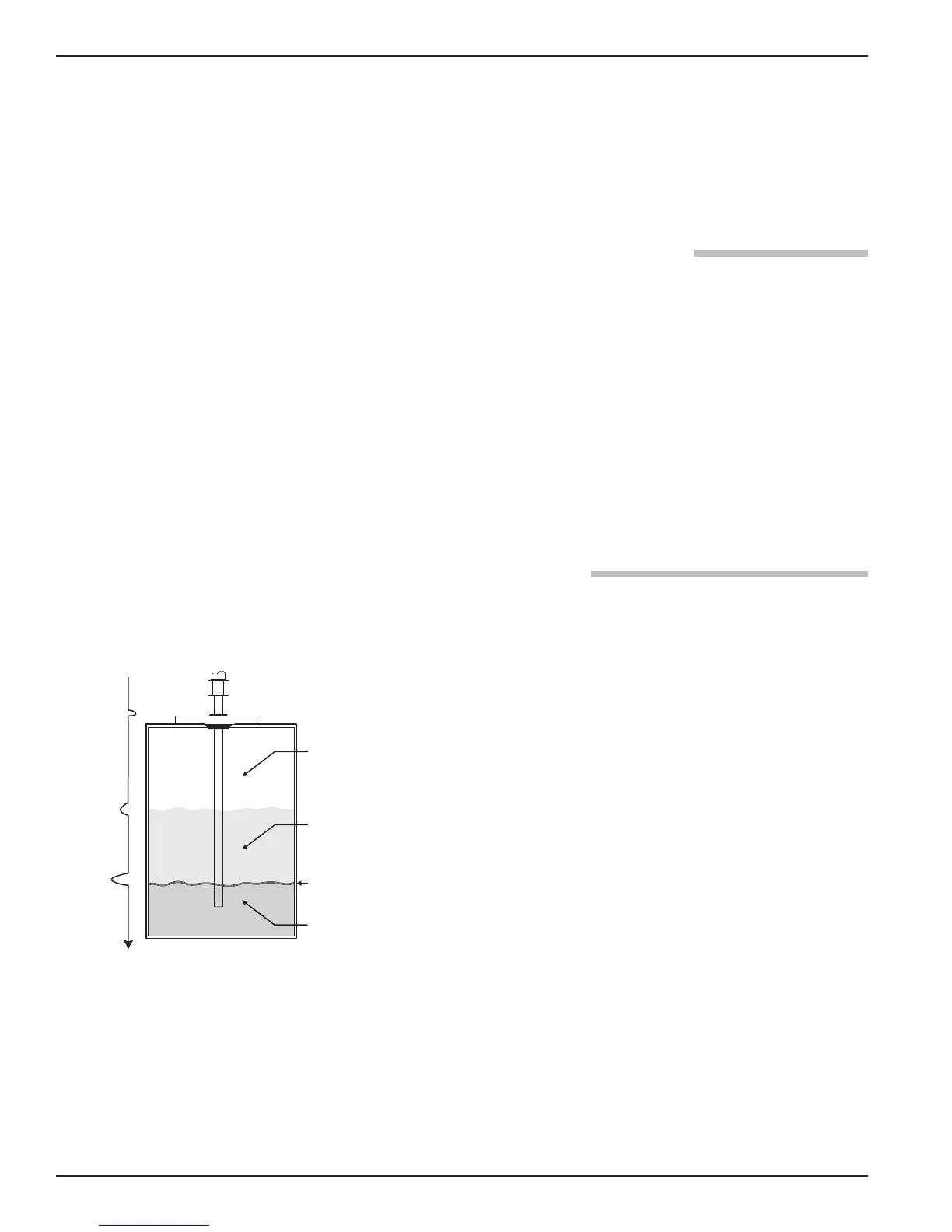
3.2.4 Interface Detection
The ECLIPSE Model 706, when used with the appropriate
probes, is a transmitter capable of measuring both an upper
level and an interface level. It is required that the upper
liquid have a dielectric constant between 1.4 and 10 and the
two liquids have a difference in dielectric constants greater
than 10. A typical application would be oil over water, with
the upper layer of oil being non-conductive with a dielectric
constant of approximately 2 and the lower layer of water
being very conductive with a dielectric constant of approxi-
mately 80. This interface measurement can only be accom-
plished when the dielectric constant of the upper medium is
lower than the dielectric constant of the lower medium.
As mentioned above ECLIPSE Guided Wave Radar is based
upon the technology of TDR, which utilizes pulses of elec-
tromagnetic energy transmitted down a wave guide (probe).
When the transmitted pulse reaches a liquid surface that has
a higher dielectric constant than the air (dielectric constant
of 1) in which it is traveling, the pulse is reflected and ultra
high speed timing circuitry provides an accurate measure of
liquid level. Even after some of the pulse is reflected from
the upper surface, energy continues down the length of the
probe through the upper liquid. The pulse is again reflected
when it reaches the higher dielectric lower liquid (refer to
figure at left). Since the propagation speed of the signal
through the upper liquid is dependent on the dielectric
Low Dielectric
Medium
(e.g. oil,
ε = 2)
Air
(
ε = 1)
High Dielectric
Medium
(e.g. water,
ε = 80)
Emulsion Layer
Reference
Signal
Upper Level
Signal
Interface
Level
Signal
Time
Interface Detection





 To Next Page