4 Product description
Messko GmbH 202018 BA4001150/10 ENMSENSE
®
DGA 2/3
4.2 Function description
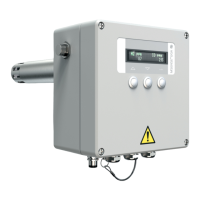
The MSENSE® DGA 2/3 measuring head is positioned in the transformer in-
sulating oil. There is often a large distance between the measuring head and
the origin of the gases. It is therefore important for the early detection of
gases that the oil at the installation position is in motion, either due to natural
convection or due to artificially generated oil circulation. Observe the addi-
tional information regarding this in the chapter "Installation recommenda-
tions" [►Section 6.1, Page 24].
The gases dissolved in the oil are dissolved out via a capillary membrane in
the device measuring head. Sensors for hydrogen and carbon monoxide
(depending on the version) convert the concentrations of gas present into
electrical signals. A gold coating prevents unwanted chemical reactions that
could distort the measured results.
The device controller converts the electrical signals into gas concentration
values in the unit ppm (parts per million). To improve the measurement re-
sults under different operating conditions, factors such as the oil temperature
and ambient temperature as well as the flow velocity of the oil at the sensor
head are taken into account.
In addition, the device is equipped with a sensor for measuring the level of
moisture in the oil. This measurement is also taken at the measuring head
directly in the oil.
The measured values determined are stored in the internal device database
and, if the device is equipped with a display, they are also displayed on it.
The current and historical measured data can be called up and analyzed fur-
ther with the MESSKO® MSET parameterization software.
The measured values, along with warning and alarm information, can be
transmitted remotely via the analog interfaces and relay outputs on the de-
vice. Furthermore, communication via various in-part optional protocol inter-
faces for connection with SCADA systems is also possible.


 To Next Page