65
5. OBSERVATION METHODS
5.1. Bright field observation
NIB610/NIB620: Basic settings for bright field microscopy
(see chapter 3.5.1.)
NIB630: Bright field settings according to Koehler (NIB630)
(see chapter 4.5.1.)
5.2. Phase contrast observation
5.2.1. Overview
Phase contrast microscopy is used to convert invisible phase shifts into
differences in brightness that are perceptible to our eyes. This effect is achieved
by the interference of diffracted light from the object and direct microscopic
light. The phase shift through the specimen is thus converted into a change
in amplitude. This enables direct imaging of structures that have only a low
inherent contrast and would only be visible with artificial coloring in bright
field microscopy. These include, for example, plankton organisms or activated
sludge. Cell cultures or cells in the urine sediment can also be better visualized
with phase contrast and thus be evaluated more quickly and reliably.
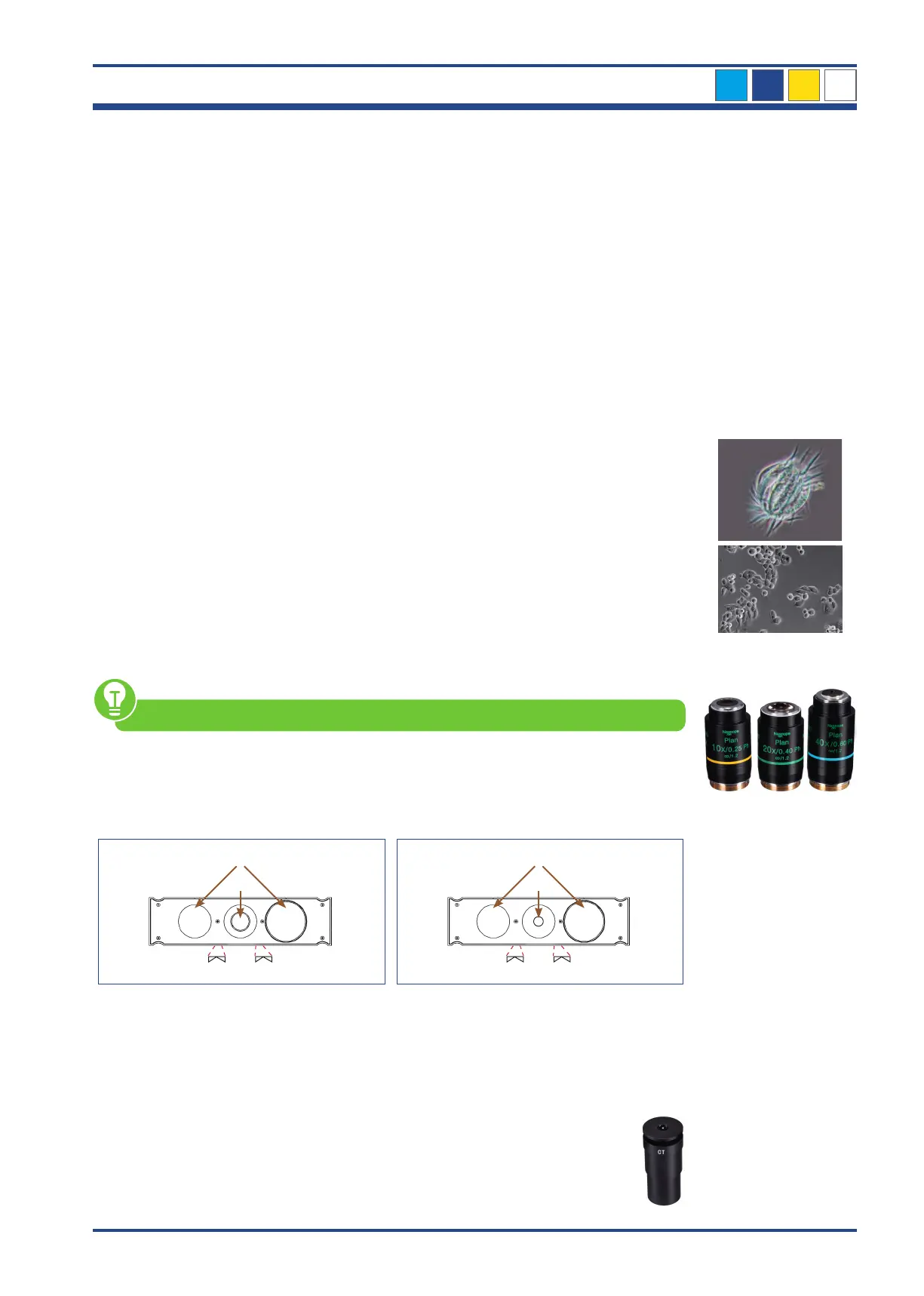
Illustration 56: Example images for phase contrast, source: NEXCOPE.
5.2.2 Components for phase contrast observation
All components are included in the scope of delivery.
• 3x Planachromatic phase contrast objectives
(NIS60): 10x, 20x, 40x
• Universal phase contrast slider
NIB630
2
3
1
NIB610/NIB620
2
3
1
Phase contrast and bright field observation is possible.
The slider matches with the 10x/20x/40x phase contrast objectives.
1. Hollow position position without ring diaphragm
bright field observation
2. Ring diaphragm phase contrast observation
3. At the side are centering screws
• Centering telescope (CT): serves for better centering
5
OBSERVATION METHODS
10-20-40 10-20-40



 To Next Page