72
Chapter 6: Cleaning and Maintenance
6.1 Start-up and Diagnostic Routines
1. The first time operating OpenSPR-XT™, or after a new Flow Cell is installed, the instrument
should be run with buffer at maximum pumping speed for 30 minutes to ensure no leaks are
present and ensure that there are no bubbles being introduced into the fluidic pathway.
Observe the response over 30 minutes as it should remain stable with minimal drift and signal
spiking.
2. Routine testing of the instrument is important to ensure it is functioning properly. Injections
of glycerol diluted in water (5-10%) or 25 mg/mL sugar dissolved in water can be used to verify
the performance of the instrument. These solutions will cause a background refractive index
change, causing a temporary increase in the signal. This will confirm that the fluidic system and
gold sensor are working properly. This should be done during initial instrument setup, when a
new user is being trained, or when a new Flow Cell is installed. These injections can be
repeated multiple times to ensure consistent and reproducible injections are made. It is also
recommended to perform one of these injections during each binding test to ensure
consistent performance, and so that the exact start and end time of the injection are known.
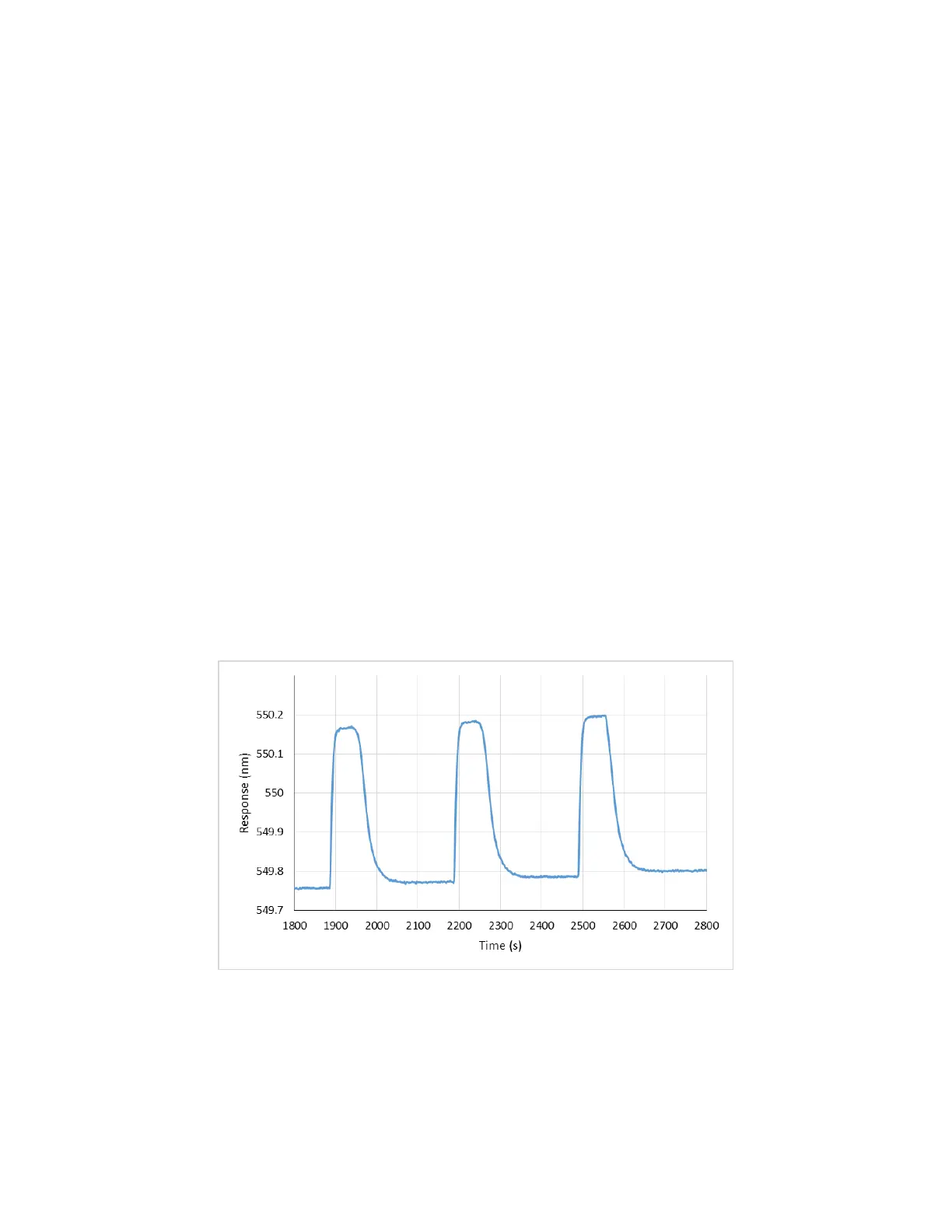
An example of the shape of a good, repeatable sugar injections with the proper shape is shown
in [Figure 6.1], whereas several examples of bad sugar injections are shown in [Figure 6.2]
indicating sub-optimal performance. In the case of the bad sugar injections, air bubbles were
present in the flow cell or injection port.
Figure 6.1 - Repeatable sugar injections are an indication of proper instrument function.



 To Next Page