22
Design and Operating Procedure Examples Section 1-6
System Configuration
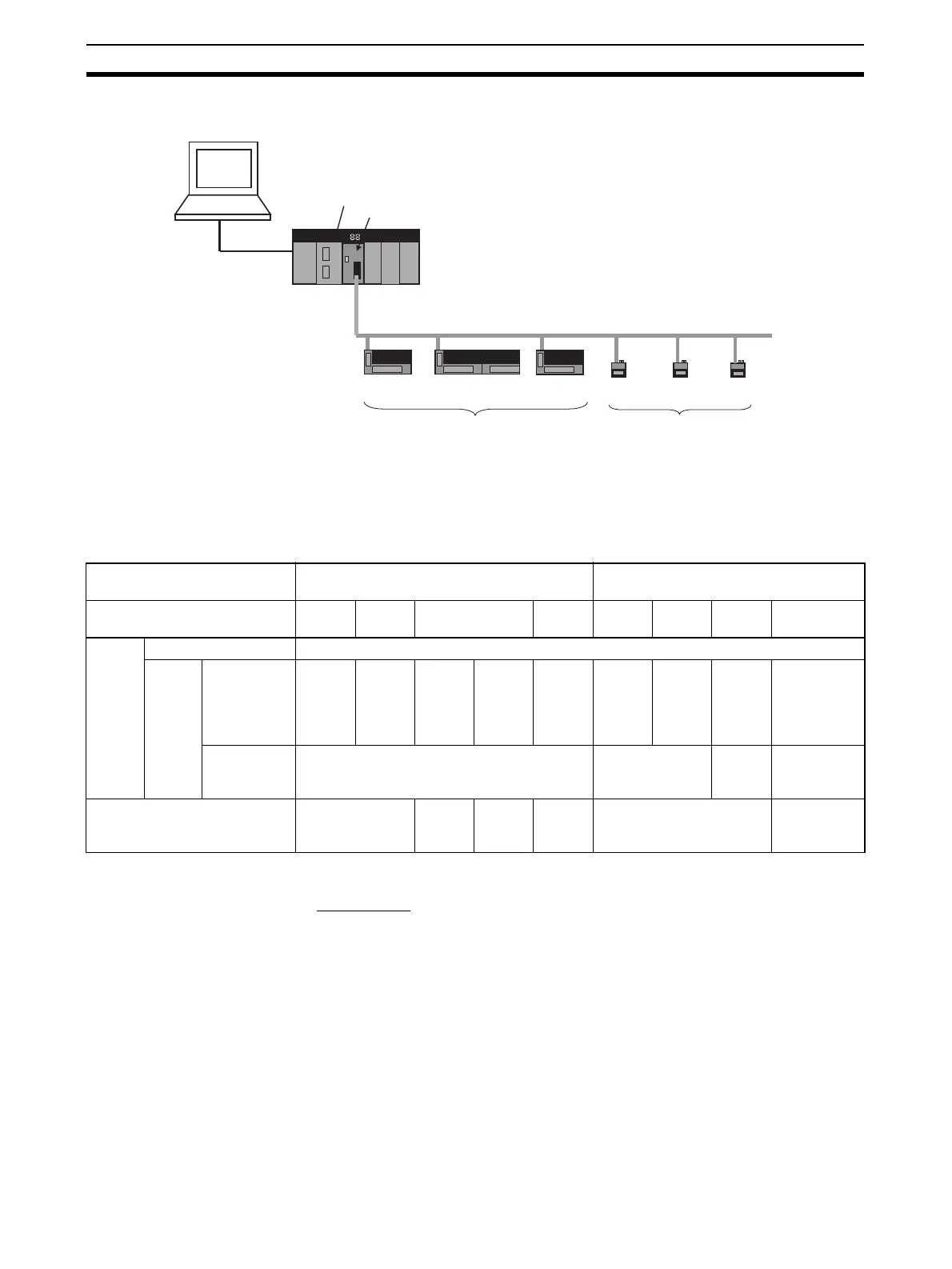
Layout • Wiring form: Branching from trunk line to branch lines, with no sub-branch
lines
• Wiring distance: 30 m or less, so any cable type or baud rate is accept-
able.
• Communications Power Supply to Slave Units: Supplied to all collectively.
■ Remarks
Wiring Form
• When there is no branching, any combination of cable types and baud
rates are supported.
• When there is a branch, Round Cable I, Round Cable II, Flat Cable I and
Flat Cable II cables cannot be used at a baud rate of 4 Mbps. This means
you cannot use a Bit Slave Unit with a pre-attached cable at 4 Mbps.
When a Round Cable I cable is used at a baud rate of 1.5 Mbps, the trunk
line and the sub-trunk line must be no longer than 30 m.
• When a branch line has a sub-branch line, Round Cable II, Flat Cable I, or
Flat Cable II cables must be used either at a baud rate of 1.5 Mbps or
93.75 kbps.
Computer (CX-Integrator)
CompoNet Flat Cable
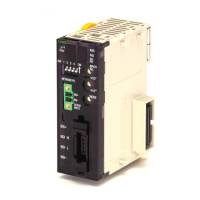
CJ-series Master Unit
CJ-series PLC
CJ-series CPU Unit
16 inputs
#0
16 inputs + 8 outputs
#1
16 outputs
#2
Word Slaves
2 inputs
BIT#0
2 inputs
BIT#1
2 outputs
BIT#2
Bit Slaves
Cable type Round Cable I Round Cable II, Flat Cable I, or Flat
Cable II
Baud rate 4 Mbps 3 Mbps 1.5 Mbps 93.75
kbps
4 Mbps 3 Mbps 1.5
Mbps
93.75 kbps
Wiring
form
No branch lines All can be used.
With
branch
lines
Without
sub-branch
lines
(branch line
extension)
Not
sup-
ported.
Sup-
ported
(0.5 m).
Not
sup-
ported.
Sup-
ported
(2.5 m)
Sup-
ported
(6 m).
Not
sup-
ported.
Sup-
ported
(0.5 m).
Sup-
ported
(2.5 m).
Supported
(unrestricted
branching).
With sub-
branch lines
Not supported. Not supported. Sup-
ported
(2.5 m).
Supported
(unrestricted
branching).
Maximum length for trunk
lines and sub-trunk lines
30 m 100 m 30 m 500 m 30 m 200 m (unre-
stricted
branching)




 To Next Page