51
CompoNet Network Wiring Section 3-2
Models other than the DCA5-4F10 can also be used as long as they conform
to CompoNet specifications. Ask the cable manufacturer for applicable prod-
ucts.
Note (1) For additional information on applicable cables to CompoNet and their
manufacturers, refer to the ODVA home page.
(2) The characteristics of each conductor in a Flat Cable I or Flat Cable II ca-
ble have been adjusted to the specific application of the conductor as list-
ed in the table. Check the insulator colors, and use them only for the
specified application.
Selecting Cable Types Refer to Types of Cables on page 24, and select applicable cables.
Using Different Cable
Types
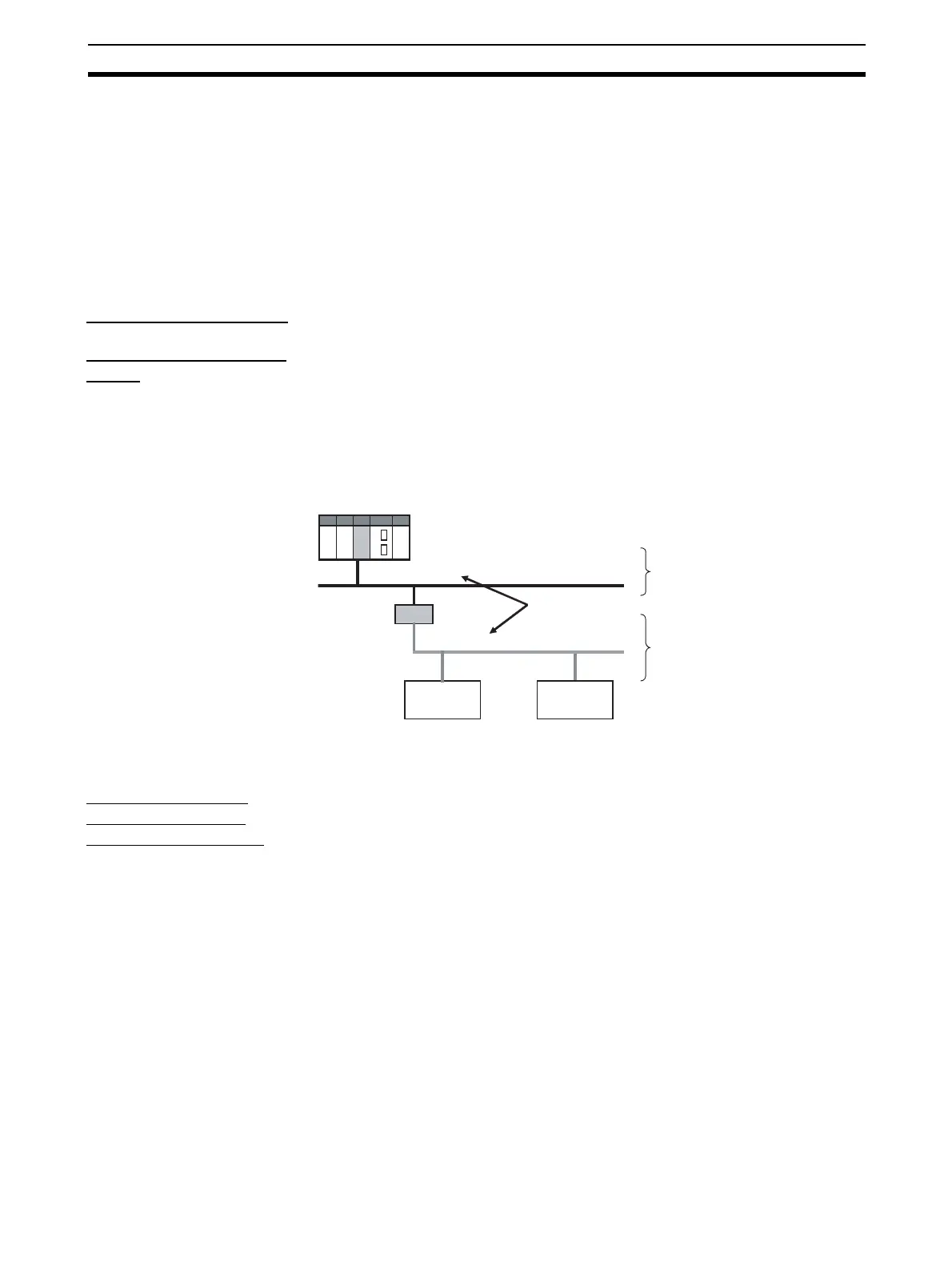
All cables downstream from the Master Unit must be the same type. That
means the same type of cable must be used for the trunk line and their branch
lines; for sub-trunk lines and their branch lines; and branch lines and their
sub-branch lines.
If a Repeater Unit is used, however, cables can be different upstream and
downstream from the Repeater Unit, i.e., for the trunk line and sub-trunk lines,
and for a sub-trunk line and another sub-trunk line. Refer to the following illus-
tration.
Note Round Cable I, Round Cable II, Flat Cable I and Flat Cable II cables
are all treated as different types of cables.
Cable Separation
between Multiple
CompoNet Network
When more than one CompoNet network uses Flat Cable I or II cables, elec-
trical interference may disturb stable system operation. To prevent interfer-
ence, do not bundle Flat Cables from different CompoNet networks. Instead,
separate the Cables for one network by at least 5 mm from cables for other
networks.
Repeater Unit
Slave Unit
Cable
Slave Unit
Cable
Different types of cable can be used.
The same type of cable must be used.
Master
Unit
The same type of cable must be used.




 To Next Page