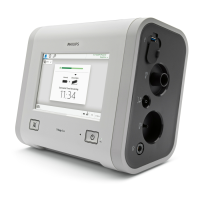
Setting up the ventilator for use
5-9
d. VERIFY that the blue “Running on Internal Battery” message is
displayed.
6. Install a fully-charged battery and reconnect the ventilator to AC
power.
7. Repeat step 5 to verify that the ventilator switches over to battery
power.
Running alarm tests The ventilator performs a self-check during start-up and continuously during
operation. Alarm functionality is verified by this self-check. You may also want
to run alarm tests, which demonstrate the alarms’ operation. Follow these
steps to perform the tests.
WARNING: To prevent possible patient injury, always return alarm settings to
hospital-standard values after verifying ventilator operation.
Preparation
1. Set the ventilator up as for normal ventilation, complete with
breathing circuit (PN 582073 or the equivalent) and a 1-liter test lung
assembly (PN 1021671).
2. Set the mode to S/T and make the following control settings: Rate:
4 BPM, IPAP: 10 cmH
2
O, EPAP: 6 cmH
2
O, I-Time: 1 sec, Rise: 1,
Ramp: Off, O
2
: 21%.
3. Make the following alarm settings: Hi Rate: 90 BPM, Lo Rate: 1 BPM,
Hi V
T
: 2000 mL, Lo V
T:
OFF, HIP: 50 cmH
2
O, LIP: OFF, Lo
E
: OFF,
LIP T: 5 secs.
High Inspiratory Pressure
1. Lower the HIP alarm limit to 8 cmH
2
O.
2. VERIFY that the
High Inspiratory Pressure alarm is activated, the ventilator
cycles into exhalation, and pressure falls to 6 cmH
2
O (the EPAP
level).
3. Raise the HIP alarm limit to 15 cmH
2
O.





 To Next Page