___________________________________________________________________________________________________________
Part Number 6300-095D Page 34 of 43
4-Wire/Kelvin Resistance Measurement
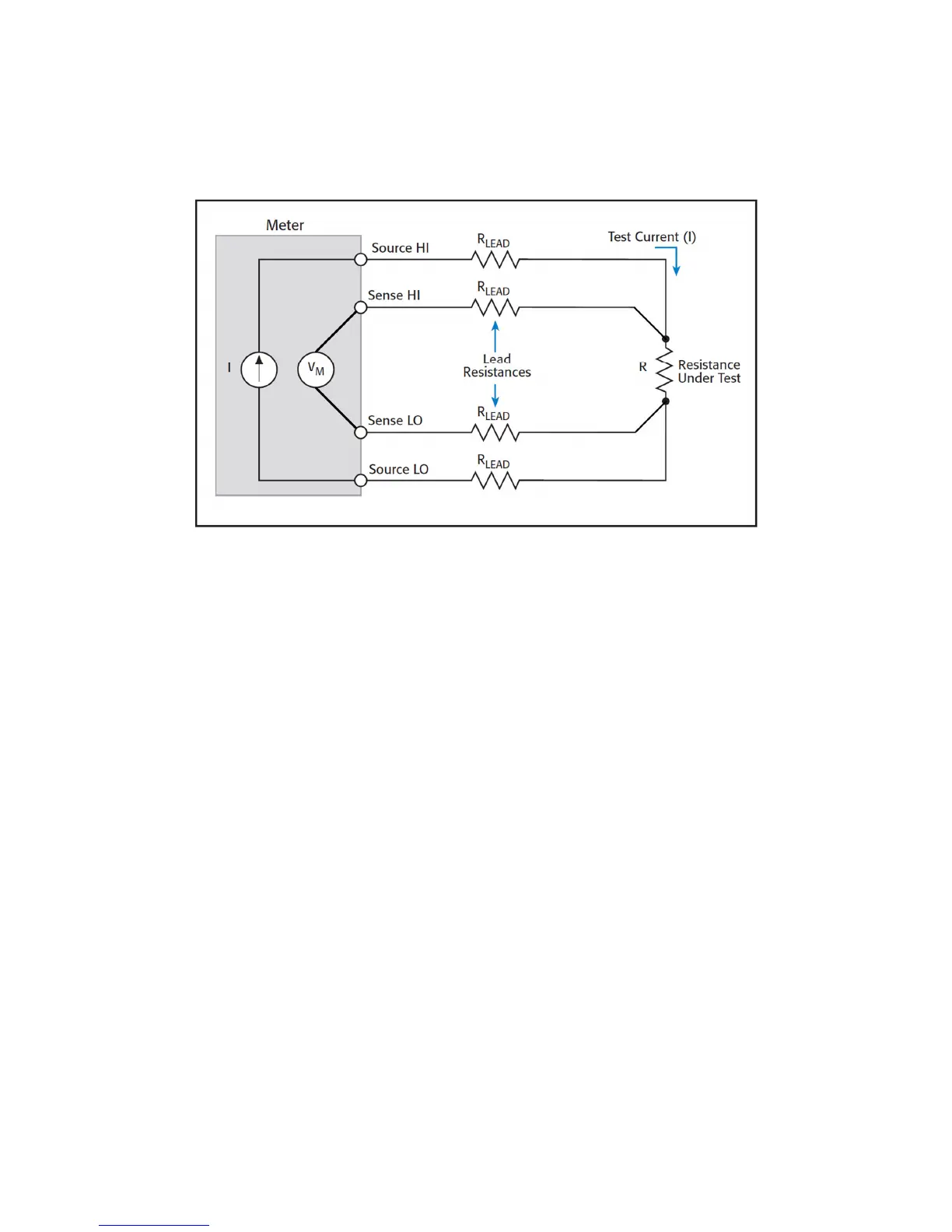
To reduce the effect of lead and contact resistances, the 4-wire or Kelvin connection method can be used. This method
requires 4 wires and thus 4 terminals at the meter as shown below. With this configuration, the test current is driven
through the resistance under test using one set of leads called the Source leads. The voltage developed across the
resistance under test is measured by another set of leads called the Sense leads. The Sense leads should be
connected as close as possible to the resistance under test for highest accuracy.
With this method, the test current does not flow in the Sense leads so there is no voltage developed across their
resistance. In addition, as the Sense leads are connected directly at the resistance under test, the voltage developed by
the test current flowing through the resistance of the Source leads is not measured. Thus, the meter only measures the
voltage due the test current flowing through the resistance under test which results in a more accurate reading that is not
influenced by the meter leads.
NOTES:
• A very small, negligible, current does flow in the Sense leads due to the input circuitry of the meter. As long
as this current is much smaller than the test current, it does not significantly affect the resistance
measurement and can be ignored.
• The method of physically connecting the leads at the resistance under test can affect the measurement. If
there is any appreciable contact resistance at the resistance under test due to the physical position of the
leads, this contact resistance can be measured by the meter and offset the true resistance measurement.
The internal resistance of batteries used with large UPS can range from less than 1mΩ for 2V batteries up to
20mΩ for 12V batteries so we can see that a 2-wire approach can result in a large measurement error if lead and
contact resistance are not considered.
The 4-wire or Kelvin connection method is recognised as the most accurate way to measure resistance when high
accuracy and/or low sample resistances are involved.


 To Next Page