
 Need help?
Do you have a question about the PreCise PF400 and is the answer not in the manual?
Provides an overview of the PreciseFlex robot system, its features, and capabilities.
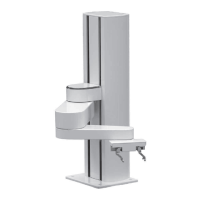
Describes the PreciseFlex 400 Robot, its axes, payload, and intended applications.
Documents the release history and significant upgrades of the PF400 robot.
Details the specifications and features of the PF3400 robot variant with a 3kg payload.
Illustrates the robot's main components and its world Cartesian coordinate system.
Describes the individual physical parts that make up the PreciseFlex 400 Robot.
Explains the functionality and specifications of the optional linear axis module.
Provides instructions and considerations for mounting the robot and linear axis.
Discusses the available options for robot grippers, including electric, pneumatic, and vacuum types.
Details the Guidance 1400B controller, its capabilities, and connectivity options.
Describes the low voltage power supplies used by the PreciseFlex robot for operation.
Explains the function of the energy dump circuit in managing power fluctuations.
Covers the hardware interfaces for manual control and emergency stopping.
Details the optional RS485 IO module for expanding digital input/output capabilities.
Describes the Remote IO module that connects via Ethernet for expanded I/O.
Explains the machine vision system and camera integration with the robot controller.
Discusses safety considerations related to the robot's operation and movement.
Lists the safety standards and agency certifications the robot complies with.
Details the robot's compliance with industry standards and agency certifications.
Provides safety guidelines for operating the robot in motion, including manual and computer modes.
Outlines the electrical requirements and power considerations for the robot system.
Explains the physical and programmed limit stops for robot axis movement.
Describes the different types of emergency stop (E-Stop) functions and their response times.
Details the procedure for releasing the Z-axis brake to free a trapped operator.
Provides a summary of the robot's safety design for collaborative use according to ISO/TS 15066.
Discusses the increasing interest in human-robot collaboration and relevant safety standards.
Explains the process for determining the required Performance Level (PLr) for safety systems.
Details force limitations and safety thresholds to prevent operator injury during collisions.
Categorizes the different types of forces to consider when designing collaborative robot workcells.
Describes the testing procedures for robot forces and the associated safety circuits.
Outlines the safety requirements for robot controllers based on industry standards.
Discusses potential controller faults and methods for testing the controller's safety features.
Details safety circuits, failure modes, and TUV verification testing for the PF400 robots.
Specifies the environmental conditions required for proper robot installation and operation.
Describes the electrical and communication interfaces available at the robot's base.
Provides detailed dimensional drawings and specifications for the robot and its axes.
Illustrates the operational reach and movement envelope of the robot.
Shows the mounting height for fingers on the PF400 robot's base.
Shows the mounting height for the gripper flange on the PF3400 robot.
Illustrates the overall system architecture, including power distribution and major components.
Details the connectors on the controller's power amplifier board for motor and encoder connections.
Describes the connectors and interfaces available on the main control board.
Shows the connectors for the gripper and linear axis controllers.
Explains how digital outputs are routed to the outer link for gripper control.
Describes the robot's Ethernet connectivity for communication and control.
Details the RS-232 serial interface for communication and debugging purposes.
Explains the E-Stop connector on the Facilities Panel and its wiring.
Describes the MCP interface for connecting pendants, secondary E-Stop, and remote IO.
Details the optically isolated digital input signals available on the robot.
Explains the optically isolated digital output signals and their configuration.
Covers the digital I/O capabilities of the servo gripper controller.
Details the RS485 Remote IO module for expanding digital input/output capabilities.
Describes the integrated GIO function for the PF3400 3kg model.
Guides users on how to access the robot's web server interface for configuration and updates.
Provides an introduction to the system setup and configuration options via the web interface.
Explains how to use the operator control panel for monitoring and controlling robot operations.
Details the procedure for loading robot programs and updating configuration files.
Guides users through the process of upgrading the robot's system software or firmware.
Provides steps for recovering from corrupted PAC files and restoring robot configuration.
Discusses software extensions and packages that enhance robot functionality.
Details the procedure for installing or removing the optional linear axis module.
Explains how to control and operate the Precise servo grippers.
Describes a simple method for controlling the gripper's squeeze force.
Details an advanced method for controlling gripper squeeze force with asymmetric limits.
Covers the digital I/O capabilities of the servo gripper controller.
Explains the configuration and use of optional pneumatic or vacuum grippers.
Describes dedicated digital outputs provided by the G1400B controller.
Lists the essential tools recommended for performing service and maintenance procedures.
Provides guidance on diagnosing and resolving common robot system errors and problems.
Explains how to troubleshoot and reset encoder operation errors.
Details the procedure for replacing the robot's encoder battery.
Guides users through the process of calibrating the robot's encoder zero positions.
Provides instructions for replacing timing belts and motors within the robot's axes.
Explains the general procedure for tensioning the robot's timing belts.
Details the process for tensioning the timing belts for the Z column (J1).
Describes how to tension the first stage belt of the Z column.
Details the procedure for tensioning the second stage belt of the Z column.
Provides instructions for tensioning the timing belt for the J2 (shoulder) axis.
Explains belt tensioning for the J3 axis on models before 2014.
Details belt tensioning for the J4 axis on models before 2014.
Describes belt tensioning for the J3 and J4 axes on 2014 models and later.
Guides users on how to tension the belt for the optional linear axis.
Details the procedure for replacing power supplies, energy dump PCA, or J1 timing belt.
Provides instructions for replacing the main robot controller unit.
Guides users through the process of replacing the servo gripper controller.
Illustrates the wiring for a 60N gripper with a battery pigtail.
Shows the wiring connections for a pneumatic gripper.
Illustrates the wiring for a vacuum gripper.
Details the wiring for a vacuum-pallet gripper.
Explains how to replace the finger pads on the Agilent servo gripper.
Guides users through replacing the gripper spring or cable assembly.
Details how to adjust gripper backlash and center the gripper fingers.
Provides instructions for adjusting the gripper brake mechanism.
Guides users on replacing electric grippers or the slip ring harness.
Details the procedure for replacing the controller for the optional linear axis.
Provides instructions for installing the optional GIO digital I/O board.
Explains the process for replacing the main robot harness, typically a factory procedure.
Guides users on replacing the harness assembly for the robot's outer link.
Details the procedure for replacing the Z-axis motor assembly.
Guides users through replacing the J2 axis motor or timing belt.
Details the procedure for replacing the J3 axis motor or timing belt.
Guides users through replacing the J4 axis motor or timing belt.
Explains how to replace a servo gripper with a pneumatic or vacuum gripper.
Lists detailed technical specifications for the PreciseFlex 400 robot model.
Lists detailed technical specifications for the PreciseFlex 3400 robot model.
Specifies the environmental conditions required for proper robot installation and operation.
Provides a comprehensive list of part numbers for robot components and accessories.
Outlines recommended preventative maintenance schedules and procedures for the robot.
Details belt tension specifications and the procedure for using a Gates tension meter.
Lists the changes and updates made to the manual across different revision versions.

 To Next Page
 General