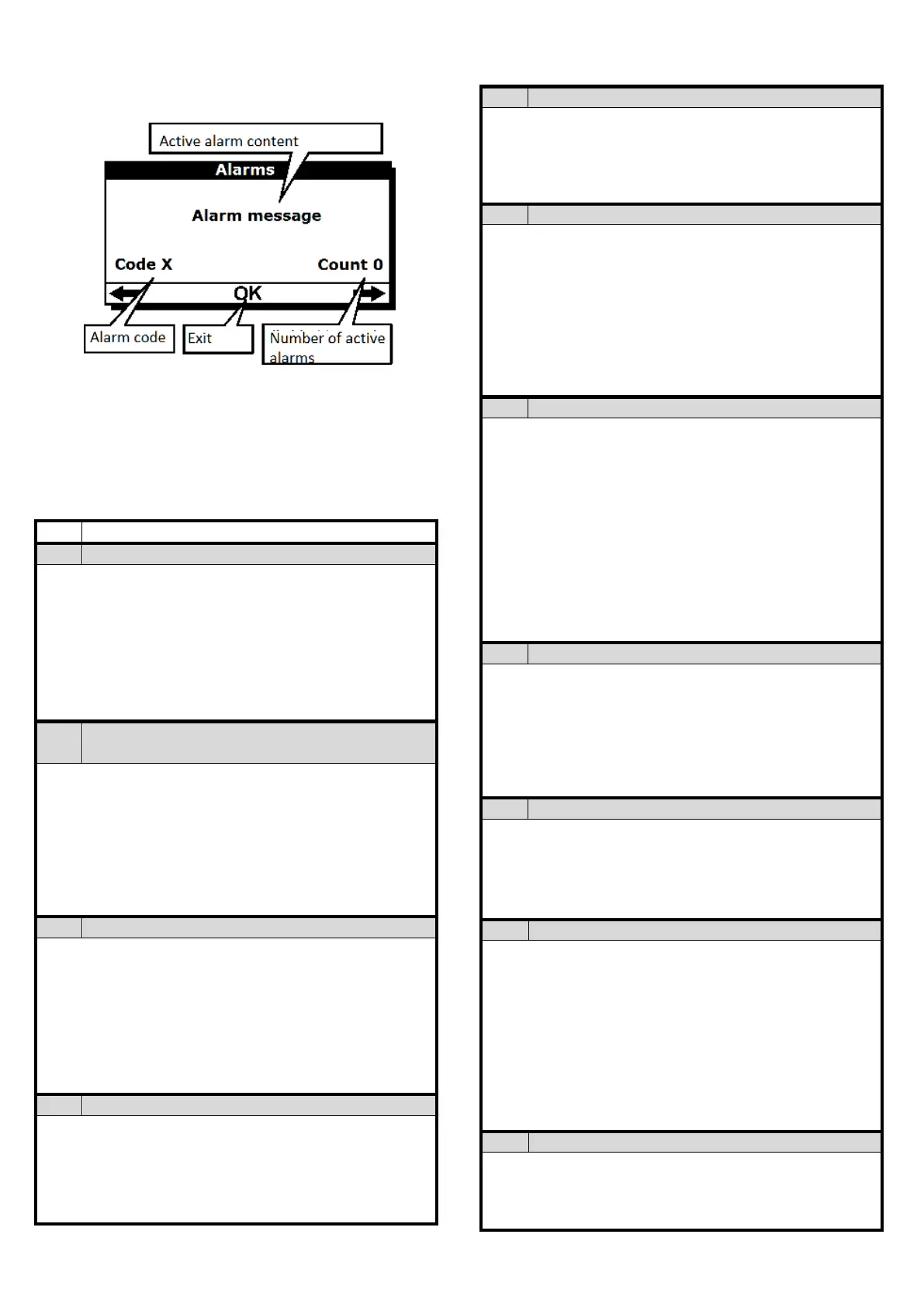
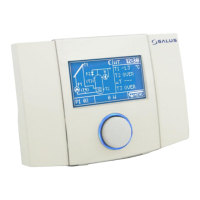
menu to Alarms we have access to contents and
code number of alarm reported by the
controller (Fig. below).
Fig. 9.1 Alarm screen
If the shown item number is higher than
1, it means multiple alarms, to be seen by
turning the knob.
Lower left corner indicates the alarm code.
Alarm codes are summarized in the table below,
to facilitate their identifications and remedies:
List of alarms
DHW reservoir overheating
Maximal DHW reservoir temperature has been
reached (exceeded temperature specified as
TDHWmax). Pump that loads heat to reservoir
is stopped. This alarm has higher priority than
collector alarms (if collector temperature alarms
occur at the same time, solar pump will not be
started whatsoever). It is required to cool
reservoir, e.g. by discharging hot water.
Solar panel overheating
P1 stop
Collector pump will be stopped by the time,
when collector temperature drops below
TCOLmax. It is possible to start pump in
manual service mode. Check work fluid flow
(possible air in system or collector pump is not
controlled).
This alarm may be due to exceeded reservoir
temperature alarm (Code 1).
Solar panel critical temperature
It means that collector critical temperature has
been reached (parameter TCOLcr) and despite
reaching temperatures (TsDHW, TsPOOL)
collector pump will be started, until collector
temperature drops below TCOLcr. Wait for
collector cool down. If menu option “Alarm
TCOLcr” is set as NO, controller will not report
this alarm, but it will take described actions.
Alarm informs on incorrect operation or damage
to T1 sensor. Check connections for continuity
(connect) or short circuit (eliminate) in sensor
circuit. Alarm will stop collector pump, algorithm
stops DHW reservoir loading.
Alarm informs on incorrect operation or damage
to T2 sensor. Check connections for continuity
(connect) or short circuit (eliminate) in sensor
circuit. Alarm will stop collector pump, algorithm
stops DHW reservoir loading.
Alarm informs on incorrect operation or damage
to T3 sensor. Check connections for continuity
(connect) or short circuit (eliminate) in sensor
circuit. This alarm depends on solar thermal
scheme. At B scheme (with heater) extra
heating of reservoir will be stopped (output H is
off) and alarm is not reported. In schemes A, C
sensor has informative function and controller
will not report any alarms from these sensors.
Alarm informs on incorrect operation or damage
to T4 sensor. Check connections for continuity
(connect) or short circuit (eliminate) in sensor
circuit. This alarm depends on Solar thermal
scheme. Alarm is reported only at schemes D, G
or K, where operational algorithm requires this
sensor. At other schemes (B, C, E, F, H, I*) T4
sensor is used to calculate heat output and its
malfunction is not reported, while heat output is
not calculated.
*T4 sensor operation in I scheme depends on dTP2
parameter, as described in section 19.1
DHW A reservoir overheating
An alarm informing that the TDHWmax defined
maximum temperature of DHW A (A buffer in
K scheme) has been reached. A pump loading
heat into this container/buffer will be halted.
Container/buffer should be cooled down, e.g. by
letting warm water our and/or disconnecting
alternative heat source from the container.
DHW B reservoir overheating
Alarm on reaching maximal temperature defined
in TDHWmax parameter in DHW B reservoir.
Pump that loads heat to this reservoir will be
stopped. Cool down this reservoir, e.g. by hot
water discharge.
Solar panel A critical temperature
In system with two collectors (only Solar
thermal scheme H) alarm on exceeding critical
temperature (parameter TCOLcr) in A collector.
Controller, despite that preset temperature
TsDHW is reached, will start collector pump P1
in order to lower temperature below critical.
Wait for collector cool down. If menu option
“Alarm TCOLcr” is set as NO, controller will not
report this alarm, but it will take described
actions.
Solar panel B critical temperature
In system with two collectors (only Solar
thermal scheme H) alarm on exceeding critical
temperature (parameter TCOLcr) in B collector.
Controller, despite that preset temperature


 To Next Page