23
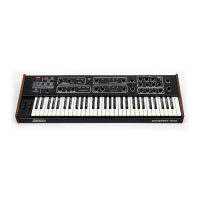
Trigon-6 Operation Manual
Filter Envelope
Decay: Sets the decay time of the envelope. After a sound reaches the
lter frequency set at its attack stage, decay controls how quickly the
lter then transitions to the cutoff frequency set with the sustain knob.
The higher the setting, the longer the decay. Percussive sounds, such as
synth bass, typically have shorter decays (and a generous amount of low-
pass lter resonance).
Sustain: Sets the lter cutoff frequency for the sustained portion of the
sound. The sound will stay at this lter frequency for as long as a note is
held on the keyboard.
Release: Sets the release time of the envelope. This controls how
quickly the lter closes after a note is released.
The description of envelope behavior above is true when the envelope amount
parameter is set to a positive value. But since this control is actually bi-polar, it is
possible to set a negative amount of modulation. In this case, the envelopes are
inverted and their behavior changes. The best way to get a feel for the difference is to
experiment with both positive and negative settings of the envelope amount parameter.
The cutoff frequency setting may limit the effect of the envelope on the lter.
For example, on the low-pass lter, if cutoff is at its highest setting, a positive enve-
lope amount will have no effect on the lter since the lter is already completely open.
Velocity: Sets the release time of the envelope. This controls how
quickly the lter closes after a note is released.
Changing the Filter Envelope’s Response Curve
By default, the envelopes of all synthesizers are designed to have certain
type of response curve that is largely dependent on the preference of the
designer. In most cases, this can’t be changed. The current preference is
that the faster or snappier the envelopes, the better.
However, in the case of the Trigon-6, there is a hidden feature in the Poly
Mod section that allows you to modify the responsiveness of the Filter
Envelope’s ADSR controls. This opens up a new level of ne adjustment
of these controls that is subtle but powerful. Try it and see.



 To Next Page