Shini Group
Technology & Marketing Dept
Issued by department: Date: Language: Document Name: Revision: Page:
Shini/CSC-TM
2013-11 zh-cn Shini product repair manual.doc
1.0 18 (62)
Catalog:
template:Standard_CN.dot; filename: Shini product repair manual; Printdate: 8/1/2014 1:58:00 PM; savedate: 8/1/2014 1:58:00 PM
maintenance and repair; however, due to the long-term repeated adsorption,
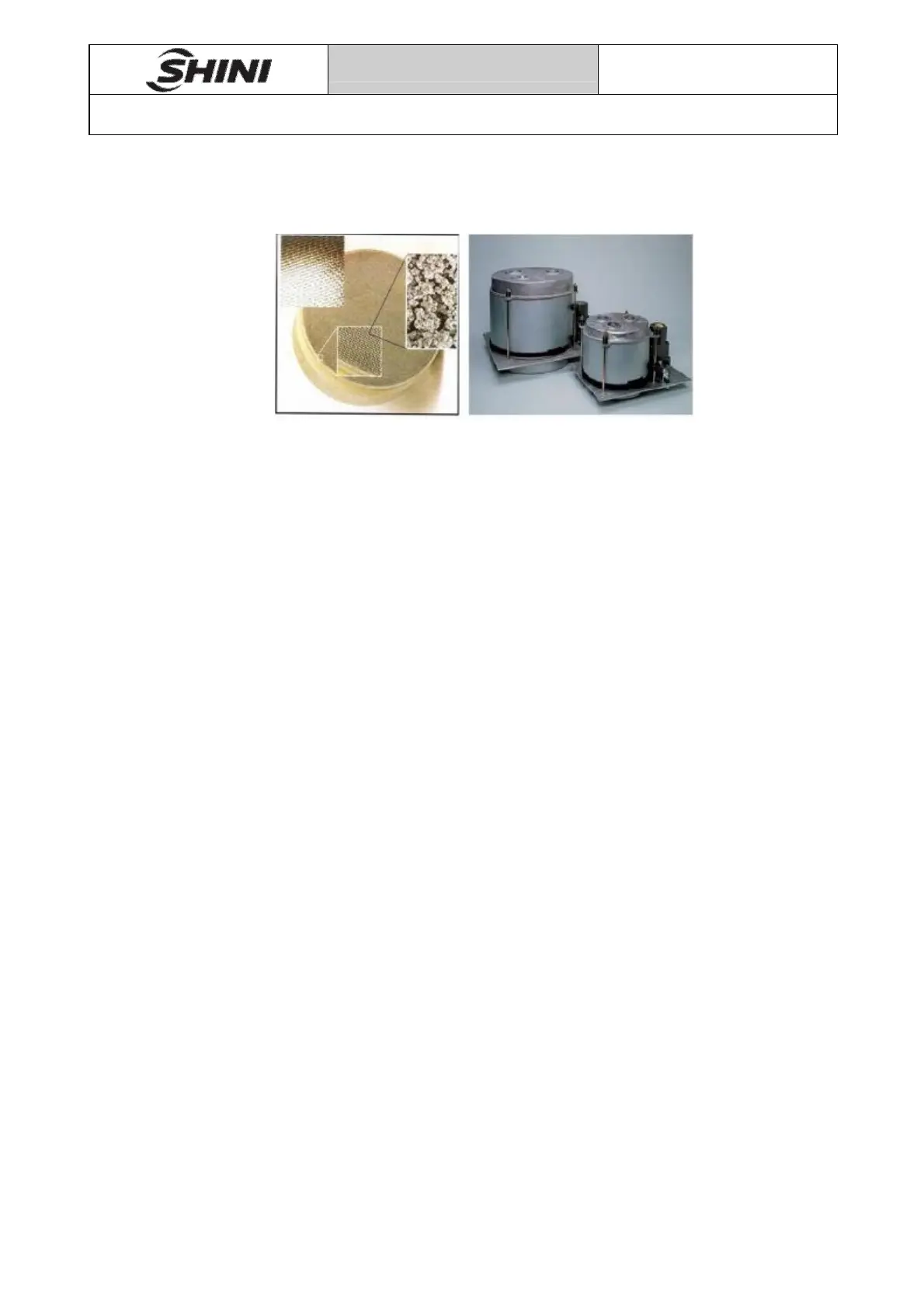
recycling, honeycomb-rotor zeolite and silica deterioration phenomenon still exists.
Pic 5-1 Honeycomb-rotor
5.4.1 Daily Maintenance
Usually using honeycomb dehumidifier will also be required to note the following:
Using compressed air to blow dust in rotor inner channel once a week, in bad air
quality cases, if the effect of dehumidified air and expectation has large difference,
you need to use compressed air to blow dust in rotor inner channel too.
Dehumidifier outlet must not have obstacles blocking, the filter should be cleaned.
Dehumidifier should be placed on a flat surface in order to avoid the machine
placed unsteadily when work.
Coolers should be cleaned regularly and kept clean.
Must not dig rotor with thin sticks, iron wire and so on, in order to avoid fault and
danger
Regularly check the honeycomb-rotor motors, sensors, speed adjuster, adjuster
pulley, belt tensioner, sprocket gear transmission parts and other components are
in proper working condition.
Regularly check and replace the seals.
Ensure that the various parts of the rotor firmly to avoid loosening.
5.4.2 Honeycomb-rotor Cleaning Method
Cleaning methods and steps are as follows:
When not using regeneration dry, blowing air humidity exceeds 60%RH to make
the rotor moisture saturation. If the air humidity below standard, you can close
regeneration electric heating, keep dry blower and drive motor continuous
operation, to make rotor moisture saturation effect. If the air is too dry, try using
humidistat to increase humidity, the step requires 1 hour.


 To Next Page