Section 1 – General information
1-4
Some eddy probe options
Armor
A flexible stainless steel jacket protects the cable.
Recommended when the cable is not protected by conduit
(such as inside a machine). Available on probe cables and
extension cables.
Certification
Approved probes and drivers can be supplied with
certification tags attached (SIRA, CSA, and FM Factory
Mutual Systems).
A word about . . .
Probe Tips
SKF uses RYTON
®
for eddy probe tips because it is
simply the best material for the job. RYTON
®
has high
dimensional stability reducing probe coil shape variations
with temperature and humidity and maintaining system
accuracy, linearity, and resolution. RYTON
®
is a “super
plastic” that has no known solvent below +400 °F
(+205 °C) and therefore highly resistant to the acids, bases
and solvents handled by process machinery.
Installation
Major considerations include temperatures, pressures, and
mechanical stress to which the probe, driver, and cables are
subjected. It is essential that the probe be rigidly mounted,
yet easily adjusted (SKF mounting accessories are ideal for
this). If long cable runs between the driver and monitor
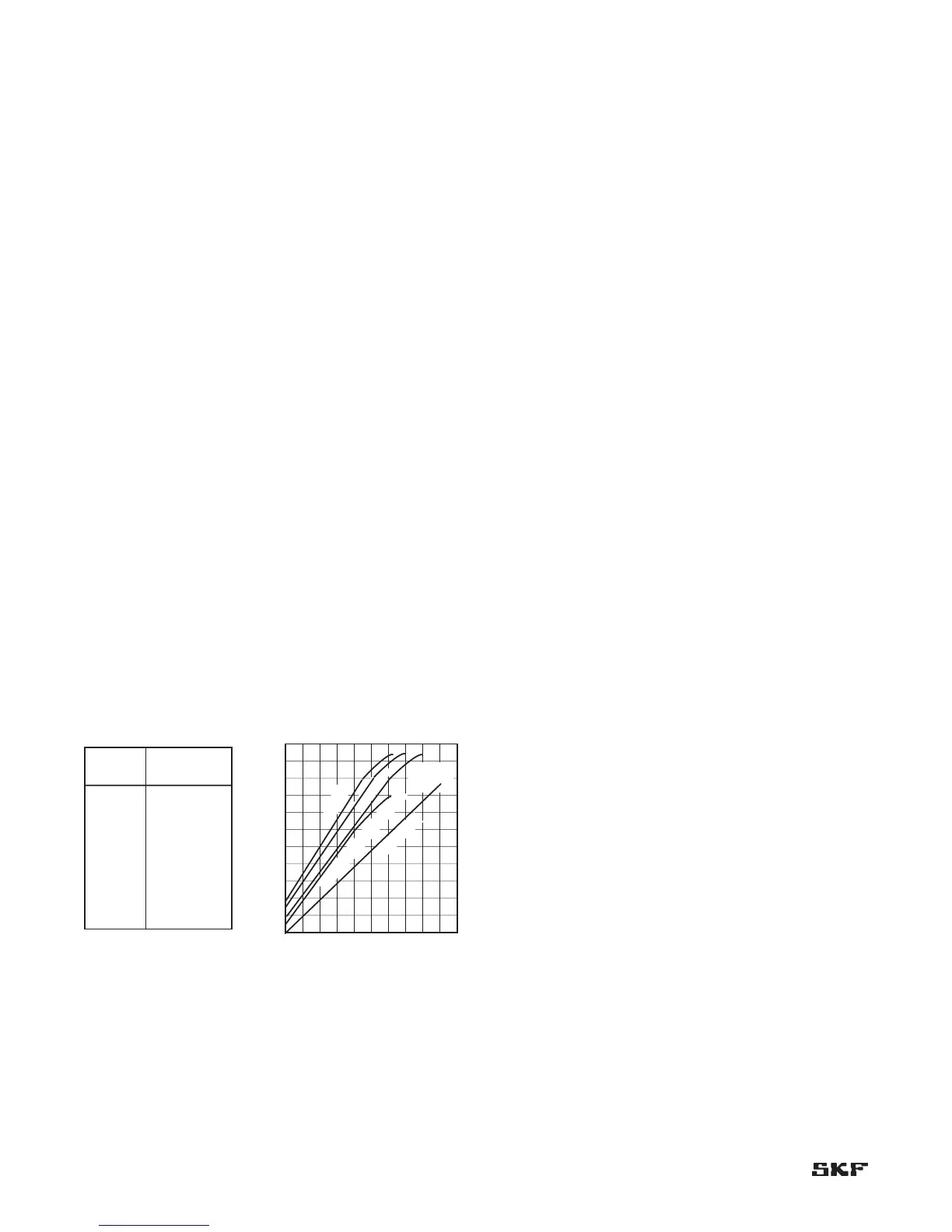
are required, consult the table in Figure 1-2 to determine
the maximum recommended wire length (use 3-conductor
shielded wire).
Figure 1-2. Wiring distance and system response variances with target
material.
Target material
Standard systems are calibrated to observe 4140 steel.
As recommended by API Standard 670, probe calibration
should be verified on a target with the same electrical
characteristics as the shaft. The SKF CMSS 601 Series
Static Calibrator and the driver trim control, permit
verification and convenient field calibration within a ±5%
range on the shaft itself. Response is dependent upon
the conductance of the target material, as illustrated in
Figure 1-2. Drivers may be special ordered for calibrated
response to different metal types. Customers will be
requested to provide samples of the metal types. Special
calibration will be “best effort” and is not a guarantee full
linear range will be attained.
Runout
Because the eddy probe works on the principle of
conductivity, shaft irregularities (flat spots, scratches,
plating, hardness variations, carbon inclusions, magnetized
regions, etc.) may produce false vibration signals. API
Standard 670 recommends runout be limited to 0.25 mils
maximum. Some irregularities, such as plated shafts,
cannot be reduced to an acceptable level with traditional
methods (peening, knurling, etc.).
Intrinsic safety
SKF monitors provide current limited power to eddy
probe systems which meet safety requirements of most
applications. However, if intrinsic safety barriers (Zener
barriers) will be used, consult the local sales representative
to ensure range, linearity, and power requirements will be
met.
API Standard 670
The American Petroleum Institute has published Standard
670 as an aid to the procurement of standardized non
contacting vibration, axial position, and temperature
monitoring systems. The standard is based on the
accumulated knowledge and experience of petroleum
refiners and monitoring system manufacturers. API
Standard 670 is a valuable reference tool for all machinery
users and manufacturers, and is highly recommended as
a guide for defining, purchasing, and installing machinery
monitoring systems.
API 670 was written to define reliable protection systems
for rotating equipment operating in the harsh conditions
found in oil production, refining, and chemical processing.
RYTON
®
based SKF Eddy Current Probes were designed
using a unique temperature chamber to test the probes


 To Next Page