Servodrives / inverters series COSMOS 301X Installation, use and maintenance manual - EN
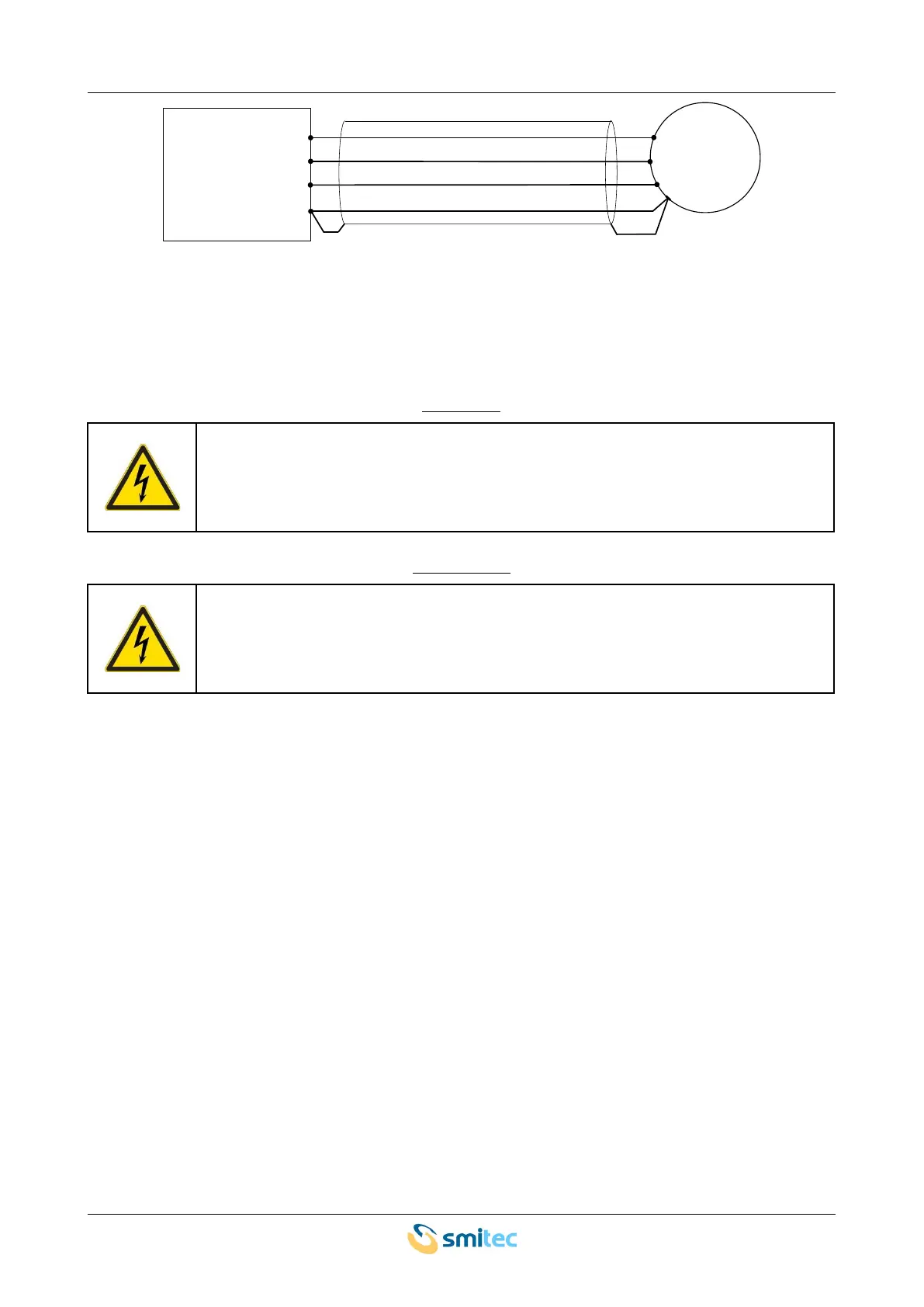
Due to the high noise levels generated by PWM modulation on the motor outputs, it is obligatory to use a
shielded cable for connecting motors. The shield must be connected to earth on both sides with a low-
impedance connection (such as a metal cam); using an unshielded cable or a shielded cable whose shield is
not connected to earth may generate EMC problems and interference with nearby devices.
CAUTION
As a safety measure, the motor must be connected to a PE (Ground) using a cable. Do
not rely solely on the electrical conductivity of the machinery frame.
ATTENTION
Par mesure de sécurité, le moteur doit être connecté à PE (Ground) en toute sécurité via
un câble. Ne vous fiez pas uniquement à la conductivité électrique du châssis de la
machine.
The motor direction of rotation depends on the order in which the phases (U, V and W) are connected. To
reverse the rotation of an asynchronous motor, simply invert two phases; in case of a brushless motor, an
incorrect connection of the phases can cause unpredictable operation and possible injury to
persons/property.
The motor cables are significant sources of noise; keep them as far away as possible from the signal cables,
in order to avoid deterioration of the signals.
Some versions of this servo-drive/inverter are equipped with a stage for piloting a resistor used to generate
dynamic braking. This function is useful when the motor must be abruptly decelerated (for example, during
an emergency stop or due to the action of cams controlling operation). When a motor is abruptly braked, a
flow of electric power is generated and directed to the servo-drive; this energy is stored in the bus capacitors,
thus increasing their voltage. If a dynamic brake stage is not included, the servo-drive will be disabled and an
error code will be generated, when the bus voltage reaches the safety threshold. In order to overcome this
problem, the device incorporates an electronically controlled IGBT that is activated when a pre-set voltage
threshold is exceeded, thus dissipating the energy of the external braking resistor.
Ver. 1.09 SMITECdd 38/74



 To Next Page