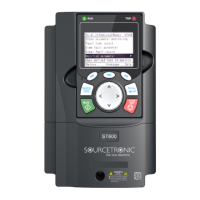
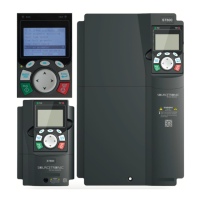
Group 8: Faults 39–42 (ENC1Z, STO, STL1, STL2)
Group 9: Faults 43–46 (STL3, CrCE, P-E1, P-E2)
Group 10: Faults 47–50 (P-E3, P-E4, P-E5, P-E6)
Group 11: Faults 51–54 (P-E7, P-E8, P-E9, P-E10)
Group 12: Faults 55–58 (E-Err, ENCU, E-PN, SECAN)
Group 13: Faults 59–62 (OT, F1-Er, F2-Er, F3-Er)
Group 14: Faults 63–66 (C1-Er, C2-Er, C3-Er, E-CAT)
Group 15: Faults 67–70 (E-BAC, E-DEV, S-Err, OtE1)
Group 16: Faults 71–75 (OtE2, E-EIP, E-PAO, E-AI1)
Group 17: Faults 75–78 (E-AI2, E-AI3, Reserved,
Reserved)
Group 18: Faults 79–82 (Reserved, Reserved,
Reserved, Reserved)
Group 19: Faults 83–86 (Reserved, Reserved,
Reserved, Reserved)
Group 20: Faults 87–90 (Reserved, Reserved,
Reserved, Reserved)
0–4
0: Run at the set frequency
1: Run at the output frequency at the time of fault
2: Run at the frequency upper limit
3: Run at the frequency lower limit
4: Run at the frequency reserved for exception
0–2
0: Invalid
1: Fire mode 1
2: Fire mode 2
When P11.53=0, the fire mode is invalid, and the
normal running mode is used. In this case, the VFD
stops when encountering a fault.
When the fire mode function is valid, the VFD runs at
the speed specified by P11.54.
When fire mode 1 is selected, the VFD always runs
except when the VFD has been damaged.
When fire mode 2 is selected, the VFD always runs, but
the VFD stops when encountering OUT1, OUT2,
OUT3, OC1, OC2, OC3, OV1, OV2, OV3, or SPO.
Note: Terminal control must be used for a fire mode.


 To Next Page
 Loading...