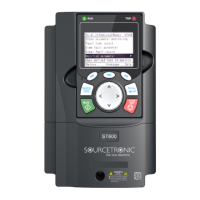
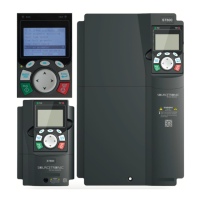
Frequency Inverter ST600 High-Performance Multifunction Series VFD Optional peripheral
accessories
-370-
D.8 Brake system
D.8.1 Brake component selection
When a VFD driving a high-inertia load decelerates or needs to decelerate abruptly, the motor runs in
the power generation state and transmits the load-carrying energy to the DC circuit of the VFD, causing
the bus voltage of the VFD to rise. If the bus voltage exceeds a specific value, the VFD reports an
overvoltage fault. To prevent this from happening, you need to configure brake components.
⚫ The design, installation, commissioning, and operation of the device must be
performed by trained and qualified professionals.
⚫ Follow all the "Warning" instructions during the operation. Otherwise, major physical
injuries or property loss may be caused.
⚫ Only qualified electricians are allowed to perform the wiring. Otherwise, damage to the
VFD or brake components may be caused.
⚫ Read the brake resistor or unit instructions carefully before connecting them to the
VFD.
⚫ Connect brake resistors only to the terminals PB and (+), and brake units only to the
terminals (+) and (-). Do not connect them to other terminals. Otherwise, damage to
the brake circuit and VFD and fire may be caused.
⚫ Connect the brake components to the VFD according to the wiring diagram. If the
wiring is not properly performed, damage to the VFD or other devices may be caused.
SP model VFDs are equipped with built-in brake units. Select brake resistors according to the specific
requirements (such as the brake torque and brake usage requirements) on site.
Table D-7 Brake unit signals for standard model VFDs
Resistance
applicable
for 100%
brake
torque (Ω)
Dissipated power of braking
resistor (kW)
Min.
allowable
brake
resistance
(Ω)


 To Next Page
 Loading...