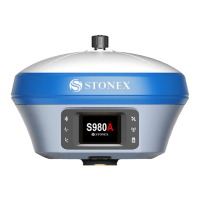
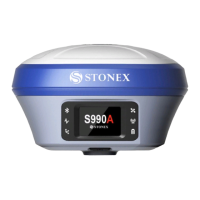
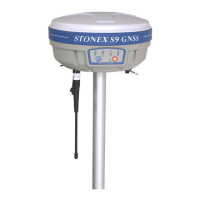
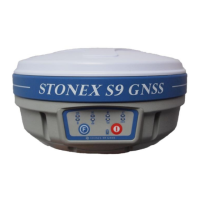
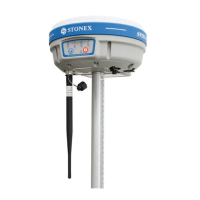
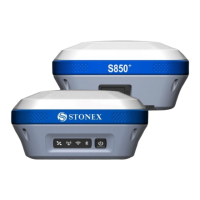
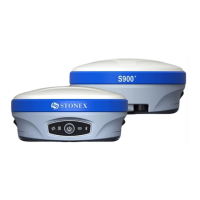
Stonex S900
+
GNSS Receiver – User Manual 47
9.4 General Antenna Installation Warning
1. All antenna installation and servicing are to be performed by qualified technical personnel only. When
servicing the antenna, or working at distances closer than those listed below, ensure the transmitter has been
disabled.
2. Typically, the antenna connected to the transmitter is a directional (high gain) antenna, fixed-mounted on the
side or top of a building, or a tower. Depending upon the application and the gain of the antenna, the total
composite power could exceed 90 watts ERP. The antenna location should be such that only qualified technical
personnel can access it, and that under normal operating conditions, no other person can touch the antenna or
approach within 0.6 meters of the antenna.
You can see below a table showing the Antenna Gain versus Recommended Safety Distance:
9.4.1 USA
The FCC has adopted a safety standard for human exposure to radiofrequency electromagnetic energy. Proper
use of this radio modem results in exposure below government limits. The following precautions are
recommended:
DO NOT operate the transmitter when someone is located less than 20 cm (7.8 inches) from the antenna.
DO NOT collocate (place within 20 cm) the radio antenna with any other transmitting instruments.
DO NOT operate the transmitter unless all RF connectors are secure, and any open connectors are properly
terminated.
DO NOT operate the equipment near electrical blasting caps or in an explosive atmosphere.
All equipment must be properly used according to the installation instructions for safe operation.
All equipment should be repaired and calibrated only by a qualified technician.
9.4.2 Europe
The European Community provides some Directives for the electronic equipment introduced on the market.
All the relevant information’s available on the European Community website:
https://ec.europa.eu/growth/sectors/electrical-engineering/
From this link, you can download Directive 2014/53 / UE RED relating to telecommunication equipment, the
LVD Low voltage directive, and the EMC directive for electromagnetic compatibility.


 To Next Page