20220323 Swegon reserves the right to alter specications.
65
WISE User Manual
Function group settings
Each room cannot have its own individual supply temperature,
but the system compares the needs of the dierent rooms in a
functional group, and then calculates which supply temperature
to use as a common setpoint. Each room with waterborne prod-
ucts is connected to a function group for cooling and a function
group for heating. SuperWISE optimizes each function group
individually by looking at the needs of all the rooms that make
up the function group. It’s possible to create up to 20 function
groups for optimization of the supply temperature, which is done
by Swegon technicians.
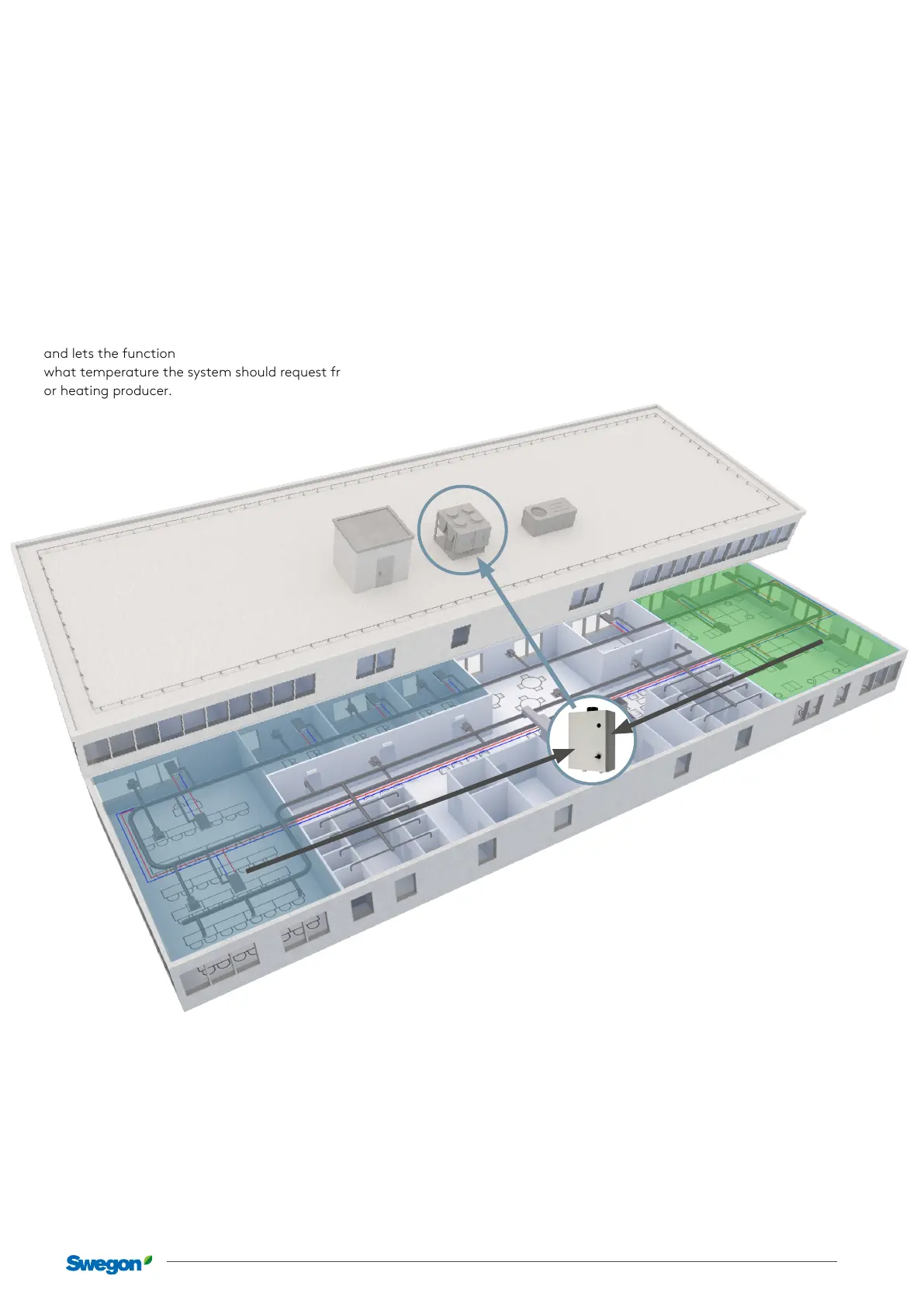
The calculated demand is connected to one of two circuits for
cooling or heating media, A or B. SuperWISE then looks at all
the optimization groups connected to the each circuit A or B
and lets the function group with the highest demand determine
what temperature the system should request from each cooling
or heating producer.
Each functional group calculates a common temperature setpoint
for the rooms in the group. SuperWISE calculates the supply ow
temperature to be requested by the producer based on the needs of
all function groups.
The following choices are possible for the function group:
• It is possible to exclude certain rooms from the tempera-
ture optimization. These rooms then risk not reaching their
temperature setpoint.
• It’s possible to choose whether the room with the greatest or
lowest need should set each function group’s setpoint value
or whether it must be the average value of all the rooms in
the group. It’s also possible to choose a weighted average
value of all rooms in the group, where rooms with a higher air
ow are weighted more heavily in the average value.
• It’s possible to divide an installation into several cooling and
heating circuits and create a function group for each circuit.
This makes it possible to obtain dierent optimized supply
ow temperatures in dierent parts of a building. It’s then
possible to use shunt groups to control the temperature
required in each circuit.
• It is possible to set within which ranges the supply ow
temperature is allowed to vary.



 To Next Page