7:10 (24), 0-004-7614-0 (GB) TAC AB, 1998-10-23
TAC 2413 Handbook Functional description
P No. Parameter Min. Max. Factory set. Change Comment
P 55 SPC/CO
2
0 0=no function, 1=SPC,
2 = CO
2
P 56 SPC effect 0 °C 32 °C 0 °C
at 2 and 10 V, respectively
P 57 CO
2
setpoint 0 V 10 V 4 V
P 93 SPC/CO
2
input signal 0 V 10 V Measured value
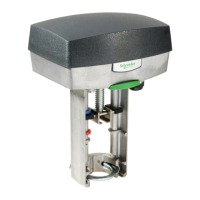
7.3.7 Mixed air damper
The outdoor, return and exhaust air dampers are controlled between an
adjustable minimum air level (30 %) and 100 % outdoor air. The
damper control is chosen using DIP switch 3. The control signal of
the damper is 0–10 V, where 0 V is equal to 0 % (closed outdoor dam-
per) and 10 V is equal to 100 % (open outdoor damper). Parameter
P 30 may be used to set the control sequence to either “Economy” or
“Comfort”. “Economy” will control the damper to the minimum out-
door air level first; then, the heating coil is controlled. “Comfort” will
control the heating coil first; then, the damper is controlled toward the
minimum outdoor air setting.
If “Economy” has been chosen, the following applies during the coo-
ling sequence:
• If the return air temperature is more below the outdoor temperature
than the “Economy limit”, an economy function is started which
controls the damper to full cooling recovery, that is the minimum
outdoor position.
The economy function is stopped when the return air temperature is
equal to or above the outdoor temperature. If there is no sensor, the
function will not be available, and the parameter is not shown.
P No. Parameter Min. Max. Factory set. Change Comment
P 30 Damper control, 0 0 = Economy, 1 = Comfort
choice of function
P 31 Min. damper position 0 % 100 % 30 %
P 37 Economy limit 0 °C 50 °C 2 °C Difference for activating
outdoor–return air the cooling recovery
7.3.8 Heat recovery
TAC 2413 is able to control all types of heat recovery by using the output
Y2. The control strategy is chosen using DIP switches 3 and 4.
The control signal is 0–10 V, where 0 V = 0 % recovery and 10 V
=100 % recovery.
The efficiency is calculated using the temperature sensors of the out-
door, return and exhaust air according to the formula on the next page.
An alarm is tripped at low efficiencies, but if there is no sensor, the
function will not be available, and the parameter is not shown.
+


 To Next Page