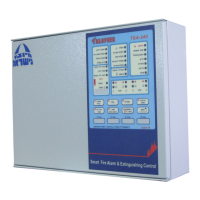
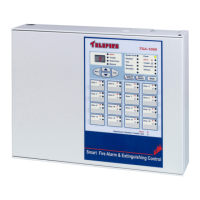
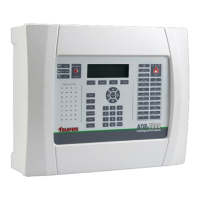
TSA-200 / TSA-200XT / TSA-240 / TSA-240XT
© 2010 – 2014 Telefire Fire & Gas Detectors Ltd Revision 1.06 July 2014
– Page 3 of 53 –
3 Important Notes
A detailed explanation of the operation of the ECD is provided later. The information in
the current chapter is provided to highlight certain issues.
3.1 Triggering Requirements
The EN 12094-1 standard (par. 4.4), requires that an ECD has to enter the extinguishing
process when triggered from a single source (zone) or from a Manual Release
Triggering Device.
Some countries require triggering from two independent transmission paths for entering
the extinguishing process.
Although the TSA-200XT and TSA-240XT are EN-54-2 compliant (and not EN-12094-1
compliant), this EN-12094 requirement is complied with in the TSA-200XT / TSA-240XT,
and is referred to in this manual as "Two Zones Coincidence".
3.2 Single Zone Activation
The TSA-200XT / TSA-240XT can be programmed to enter the extinguishing state (or
extinguishing delay, if delay is programmed) when Alarm is triggered FROM ONE
DETECTORS ZONE ONLY, where the (single) activation zone is selected by
programming.
NOTE! The default configuration of the TSA-200XT / TSA-240XT is activation on two
zones coincidence of zone 1 AND zone 2.
3.3 Two Zones Coincidence
Two zones coincidence, a mandatory requirement in some European countries, is
explained below.
When the ECD is configured for two zones coincidence, a trigger from one of the zones
which are members of the "extinguishing decision group" will change the state of the
ECD to "Fire Alarm". Trigger from a second zone, which is a member of the
"extinguishing decision group", will cause the ECD to enter the "Activated" state. If a
Non-Zero Delay is programmed, the ECD will enter the "Pre Discharge Warning Time". If
the programmed Delay is zero, or if the warning time (delay) expires, the extinguisher is
triggered immediately.
NOTE! The default configuration of the TSA-200XT / TSA-240XT is activation on two
zones coincidence of zone 1 AND zone 2.
i
Note
If zones, which are not members of the extinguishing decision group, receive
an Alarm signal, the ECD changes its state to "Fire Alarm", BUT DOES NOT
ENTER THE ACTIVATED states, and the extinguisher is NOT triggered even
if two such zones are triggered and are in the "Alarm" state.
3.4 Dependency on More Than One Alarm Signal
The TSA-200/TSA-200XT/TSA-240/TSA-240XT supports the "Dependency on more
than one alarm signal" function, also termed "Alarm Verification Function" (AVF), as
detailed in EN-54-2, para. 7.12.
The alarm Delay and Confirmation (verification) feature allows the control panel to ignore
false, short and transient alarm events, which may cause a nuisance.



 To Next Page