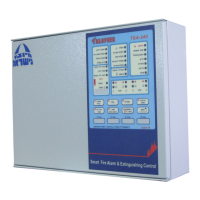
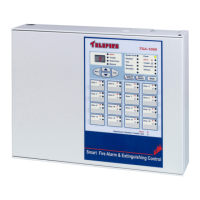
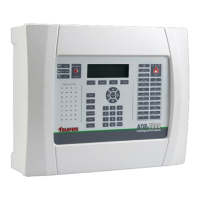
TSA-200 / TSA-200XT / TSA-240 / TSA-240XT
© 2010 – 2014 Telefire Fire & Gas Detectors Ltd Revision 1.06 July 2014
Page 68 of 79
21 Troubleshooting
21.1 Faults
When in the quiescent (Idle) state, the Power (Green) LED is ON with periodic short
OFF pulses.
When a fault occurs, it results in (at least) the following:
General Fault LED Flashes, Fault Relay activated, FWRE activated, buzzer sounds 1
second ON, 4 seconds OFF (Fault Signal).
If the fault occurs in any of the extinguishing related inputs or output, the extinguishing
zone fault LED also flashes. In addition, a fault LED of the specific port flashes also.
To assist in troubleshooting, the TSA-200XT / TSA-240XT has 5 fault LEDs on the EM1
Extinguishing expansion module, adjacent to the inputs and outputs terminal blocks.
i
Note
These support LEDs are only visible with the door open!
The LEDs are assigned to (from left to right): Extinguisher, Extinguishing Sounder,
Pressure Switch, Manual Release, and Hold.
Troubleshooting and fault analysis can be performed by observing the display, analyzing
the source of the fault by monitoring the Front Panel LEDS that flash, observing the EM1
LEDs that flash, and then dealing with the cause of the fault.
After repair, the proper operation can be verified, i.e. the CP is OK when no fault is
indicated.
21.2 Maintenance Alert
Photoelectric and multi-sensor smoke detects manufactured by Telefire have unique
physical characteristics that allow them to operate for very long period under normal
operating conditions.
The detectors perform drift compensation automatically as dust residue collects in the
detector until such time that the detector can no longer compensate for the drift. At this
point the detector will indicate the need to clean it by increasing the detector indicating
LED flashing frequency from once every four and a half seconds to twice a second.
The CP will indicate a fault, and the zone with detector/maintenance fault by flashing the
zone fault LED,



 To Next Page