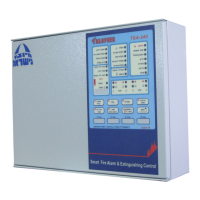
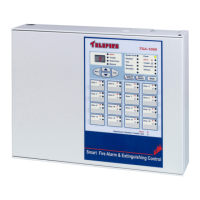
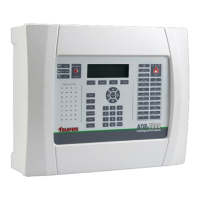
TSA-200 / TSA-200XT / TSA-240 / TSA-240XT
© 2010 – 2014 Telefire Fire & Gas Detectors Ltd Revision 1.06 July 2014
– Page 10 of 53 –
The following information supplements and highlights manufacturer’s information.
WHEN HANDLING BATTERIES, OBSERVE THE BATTERIES' MANUFACTURER’S
RECOMMENDATIONS REGARDING HANDLING, CLOTHING AND PROTECTIVE
GEAR.
For the TSA-200 product family, use two 12V 5 AH sealed Lead Acid batteries, such as
Yuasa NP5-12 or equivalent, connected in series.
Use the supplied wires to connect to the CP to the batteries, and to connect the two
batteries in series.
Since the batteries used are maintenance free, and the ECD automatically controls the
battery charging, discharge and test, NO SPECIAL maintenance is required.
OBSERVE THE FOLLOWING:
Connect the battery to the ECD main board battery terminal block using the supplied
wires. Observe polarity.
Place and connect batteries in the Control Panel, only after the Control Panel is properly
installed and is in the correct (upright) position.
Place batteries so they are adjacent to the back of the Control Panel enclosure, as
shown in the appropriate drawings in the TM.
Place protective covers on batteries' terminals when the battery wires are disconnected
from the battery.
Remove batteries (after assembling protective terminals covers) from the CP before
moving or shifting the Control Panel.
Keep the area near the batteries' terminals free of foreign objects, metals, or bare wire to
avoid shorting the batteries.
Keep the batteries clean and dry
Keep the area well ventilated
Smoking, fire or sparks ARE NOT ALLOWED near batteries.
When working on batteries, DISCONNECT THE BATTERIES AND ALL OTHER
POWER SOURCES
i
Note
If batteries show any signs of swelling, rupture, fluid leakage, emission of
gases or fluids, heating or discoloration, or accumulation of corrosion
products near the terminals, OR YOU HEAR A HISSING OR SPARKING
SOUND, disconnect the batteries and replace with a new pair of the
appropriate type and rating.
Follow the manufacturer’s instructions for cleaning the batteries and the enclosure, if
necessary
Dispose of batteries properly
Do not short-circuit, puncture, crush, or dispose of batteries in fire.
Do not connect batteries to a makeshift charger or power supply.
Do not expose the batteries or its terminals to mechanical stress
Handling of materials that leak from the batteries should be done by qualified personnel
using the appropriate protective gear, materials, and procedures.
If the ECD indicates a battery fault, check the wiring and the batteries.
If necessary, replace the batteries



 To Next Page