59
Tempest900 2-Channel Operating Manual
Accu-Sync
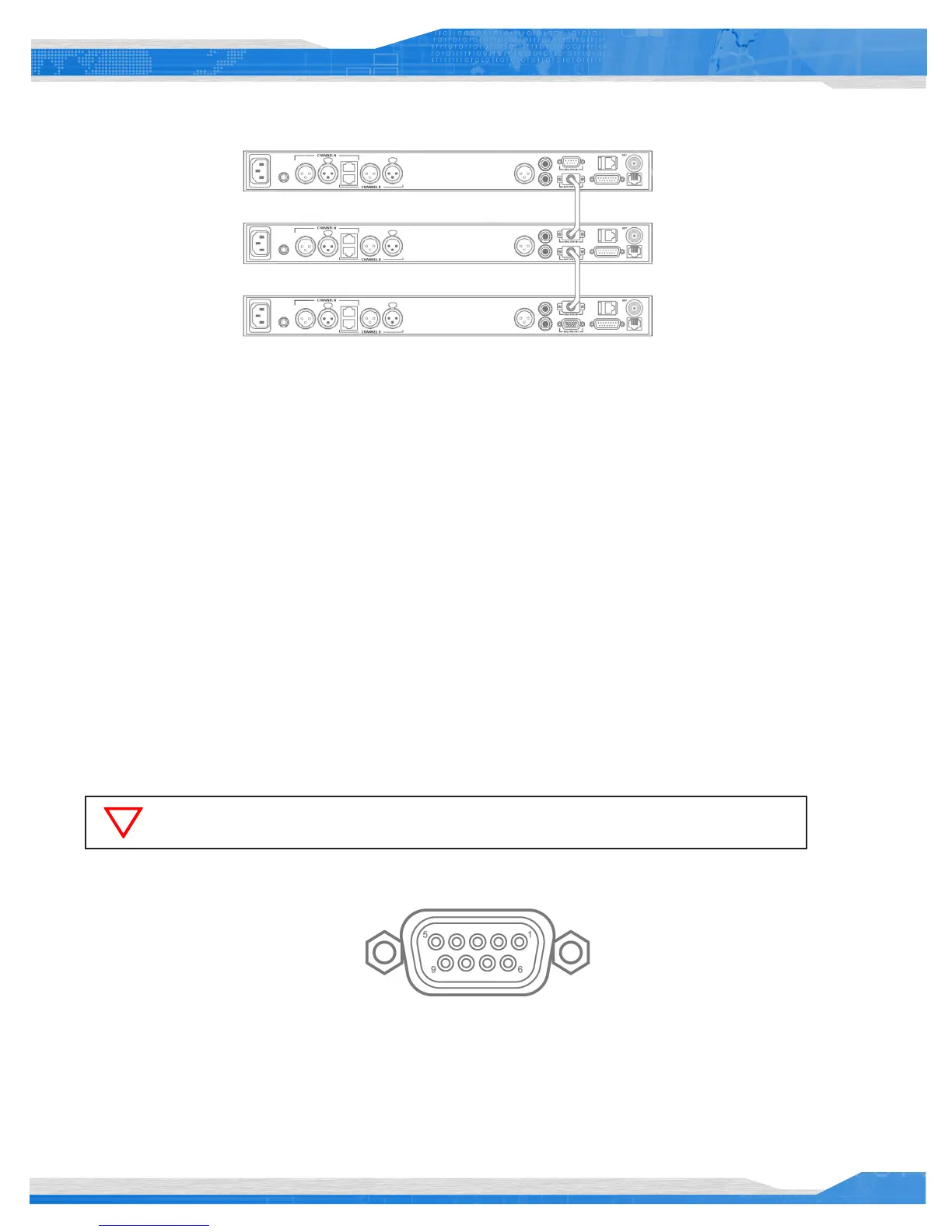
Three BaseStations Accu-Synced
Accu-Sync provides a common timing signal between connected BaseStations. This signal ensures that transmission cycles for all Accu-Synced
BaseStations occur simultaneously. This synchronized transmission eliminates the negative RF effect called desensing. See the following section,
“Special RF Considerations for Multiple BaseStations,” for more information on connecting multiple BaseStations.
When two or more Tempest BaseStations are to be operated in the same location, connecting the BaseStations via the BaseSync connector on
the back of the BaseStation, minimizes potential RF interference between BaseStations. The more BaseStations there are in close proximity to
each other, the more important it is to use Accu-Sync.
One BaseStation must always act as the sync source when using Accu-Sync. The sync source is any BaseStation that does not have a BaseSync
cable plugged into the BaseSync IN connector. Always ensure that one, and only one BaseStation has an open (no connection) BaseSync IN
connector.
When a BaseStation does not have a BaseSync cable plugged into the BaseSync IN connector, that BaseStation uses an internally generated
timing pulse to control its own transmission cycle.
When a BaseStation has a BaseSync cable plugged into the BaseSync IN connector, that BaseStation uses the external sync signal (timing pulse)
to control its transmission cycle.
The BaseSync cable is a DE-9F To DE-9M wired straight through on pins 1-5. The maximum distance a BaseSync cable can be is 1,500 feet
(457.2 m).
BASE SYNC IN
Accu-Sync - DE-9 Connector
Never connect Accu-Sync cables between 2.4GHZ and 900MHz Tempest models.


 To Next Page