16502 PIREG-C2 Gerätebeschreibung mit EtherNet_IP Bussystem191017 - EN.docx/ Page 13 of 66
4.4. Interfaces
The PIREG-C2 possesses three serial interfaces. These are an RS232 (1), an RS485 (2) and a USB
interface (3). The RS232 and RS485 interfaces use a common connector. The USB interface is used as a
virtual RS232 interface.
The RS232 and the USB interface are used for direct communication with the controller. The RS485 inter-
face is used as the interface to superordinate controls, e.g. a PLC.
4.4.1. RS232 and USB communication: The RS232 and the USB interfaces use the same command
set, which consists of alphanumeric characters. This makes it easily understandable by the user. Every
interface has a 64-byte data memory. The Baud rate can be set separately for each interface by com-
mand (BRAT). As a factory default setting, both interfaces have the following data format:
Protocol:
ASCII characters are used for the communication telegrams. Both large and small letters
may be used. The PIREG-C2 does not initiate any communication by itself to its commu-
nication partner, it behaves passively. The PIREG-C2 acknowledges every communica-
tion from its partner either with the response required or with the OK acknowledgement.
There is an error acknowledgement in the event of defective communication. For its
acknowledgements and responses, the PIREG-C2 only uses large letters.
A telegram always ends with the ASCII character number 13. The names of the com-
mands or acknowledgements are separated from the following data by a blank space.
The data to be transferred are transmitted with a constant width and, if necessary, with
leading zeros. If several data are transmitted, they are separated by blank spaces.
4.4.2. Addressed RS232 communication: Communication via the RS232 interface can also be ad-
dressed. This allows the RS232 interfaces of up to three PIREG-C2 to be connected in parallel. In this
way, a communication partner can communicate with up to three PIREG-C2 via an RS232 interface. The
addressing of the RS232 communication is switched on and off by command (KOKO). The address of the
RS232 communication is set by command (GADR) and is also used for RS485 communication. The
space for addresses covers the 0 - 250 range. The factory setting is 0.
Protocol:
The form described above is used for the telegrams of addressed RS232 communication.
The address is placed before the command, the acknowledgement and the response and
separated by a blank space. Three digits are always used for the address.
4.4.3. RS485 communication: The RS485 interface uses a binary command set to increase the rate of
communication. The interface has a 64-byte data memory. The PIREG-C2 has an address for RS485
communication that can be set by a command (GADR). This address is also used for addressed RS232
communication. This addressing means that up to 31 PIREG-C2 can be operated on the same RS485
bus. The space for addresses covers the 0 - 250 range. The Baud rate can be set by command (BRAT).
The address 0 is the factory setting and the interface has the following data format:
Protocol:
The protocol used is based on DIN 19244. The PIREG-C2 does not initiate any commu-
nication by itself to the master in the bus system, it behaves passively. The PIREG-C2
responds with a minimum delay of 3 ms for a secure change of direction of the RS485
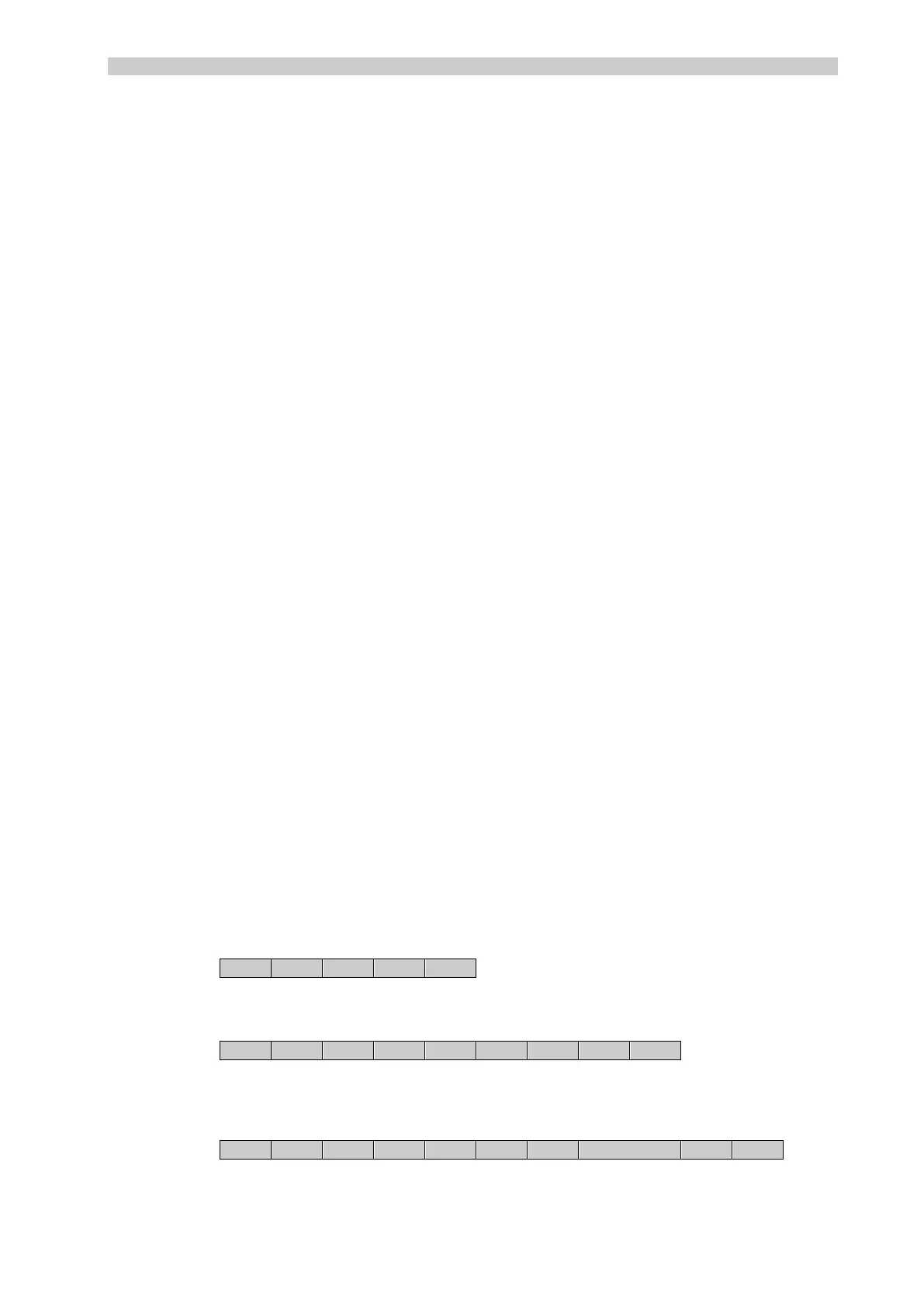
communication. The following telegram formats are used:
Short set:
Short sets are sent from the master (on the calling side) to the PIREG-C2:
to transmit short commands to the PIREG-C2 (e.g. reset).
to quickly call up important data from the PIREG-C2.
Short sets are used (on the response side) by the PIREG-C2:
to acknowledge call ups that do not require any response data.
Control set:
Control sets are only used by the master on the call-up side. They are used to call up all
the commands that cannot be called up by means of short sets because a more detailed
specification is required for them. The control set has a fixed length (LG) of three.
Long set:
Long sets are used:
to transfer commands with parameters to the PIREG-C2
to permit the master to take over data from the PIREG-C2.
The length (LG) of the long set is the length of the data block plus three.
Start charac-
ter SZ:
The start character indicates the telegram (1 byte,)
Start character for short set: 10h
Start character for control set and long set: 68h


 To Next Page