16502 PIREG-C2 Gerätebeschreibung mit EtherNet_IP Bussystem191017 - EN.docx/ Page 22 of 66
Description: Clear the contents of the error memory with the status z=1. The PIREG-C2 stores the last
100 error events. After deletion, all values of the memory locations are zero.
Example Write: SFESL 1
RS232/USB: Response: QOK00
Example Write: 68 04 04 68 21 69 6C 01 F7 16 (GA=21h)
RS485: Response: 10 21 00 21 16
Reference: FESP
4.7.8. FESP command
Syntax Read: LFESP
RS232/USB: Response: n;hhhhhh:mm:ss;abcd efgh (100 times)
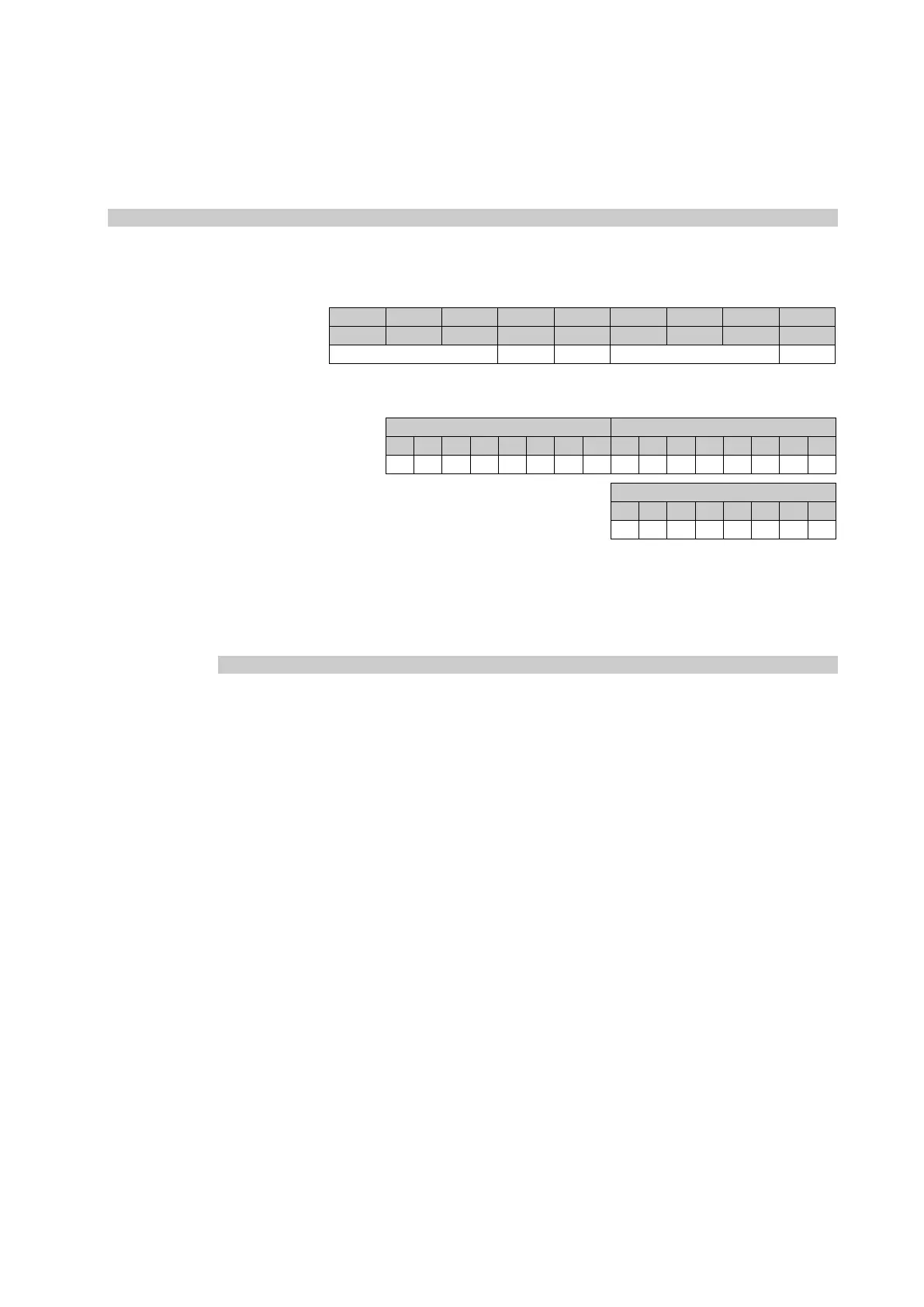
Syntax: Read: Control set, BI = 76h
RS485: Response: Long set with DB0…DB8 (100 times)
Note: For reasons of downward compatibility, bit "c2" of parameter "C" is
in data byte DB8 as bit 4 and bits "d2" and "d3" of parameter "D" are in
data byte DB8 as bits 5 and 6. (see FEZU command)
Description: Read out the contents of the error memory of the PIREG-C2 controller. The PIREG-C2
stores the last 100 error events. The output is in CSV format. All values are zero for un-
occupied memory locations. The output is in 100 lines. The error with the number 1 is the
newest error event. The error with the number 100 is the oldest error event.
In RS485 communication, the hundred long sets of the response are sent one after the
other with a pause of 3ms each.
Assignment
nnn: number of the memory location (1…100)
hhhhhh: Operating time hours (0…999999)
mm: Operating time minutes (0…59)
ss: Operating time seconds (0…59)
a Hardware error: 0= Ok 1= error
b Power line error: 0= Ok 1= undervoltage
2= overvoltage 3= line frequency error
c Data error: 0= Ok
1= Calibration values do not suit the setting
2= Read/write error in the non-volatile memory
3= Communication monitoring
4= Heating time limit exceeded
d Cal. number: 1…8, the error occurred when using this calibration
e Voltage signal Vr: 0= Ok 1= too small 2= too large 3= unstable
f Current signal Ir: 0= Ok 1= too small 2= too large 3= unstable
g Heating conductor temp.: 0= Ok 1= too small 2= too large
with temperature monitoring: 3= too small 4= too large
with heating monitoring: 5= heating time exceeded
6= heating time fallen below
Temperature jump: 7= downwards 8= upwards
h Calibration error:
0= Ok
1= Parameter error
2= Voltage or current signal defective (see above)
3= Error in determining the phase shift
4= R20 can not be determined
5= Error in determining the P-factor or P-factor monitoring
6= The selected reference temperature is too high
7= Range of temperature coefficient correction exceeded


 To Next Page