
 Need help?
Do you have a question about the VAF instruments OILCON MARK 6M and is the answer not in the manual?
Provides guidance on setting up, using, and maintaining the system.
Details the system's function in monitoring and controlling ballast water discharge.
Introduces the Oilcon® system and its main components.
Explains the meaning of symbols used in the manual for clarity.
Describes the scattered light measurement technique used by the system.
Details the system's main components and their arrangement.
Outlines general system specifications and regulatory compliance.
Specifies electrical, environmental, and input/output details for the MCU.
Details specifications for the EPU, including power, air, and mounting.
Provides specifications for the skid assembly, including flowrate and connections.
Specifies electrical, power, and mounting details for the sample pump.
Lists products and biofuel blends that the system can measure.
Details essential safety measures for handling and operating the equipment.
Lists and describes the main components of the system for unpacking.
Sets installation requirements and lists necessary utilities like water and air.
Covers general pipework, sample pump, skid, and probe installation steps.
Details requirements for making penetrations through bulkheads for pipes and cables.
Provides guidelines for general electrical installation and specific units.
Describes the installation of the Main Control Unit (MCU) in the control room.
Lists checks for general installation, flowmeter, and interlock systems.
Provides a checklist for cable connections and grounding points.
Details the MCU control panel layout and its elements.
Explains the MCU's menu structure and navigation.
Provides a quick guide for starting discharge operations and system setup.
Addresses common operational problems like high readings and alarms.
Lists and describes operational alarms and their meanings.
Provides guidance on handling system failures and manual operation.
Explains how to override system controls and manage transducer inputs.
Provides general guidelines and safety precautions for maintenance tasks.
Outlines regular maintenance tasks for system components.
Details the procedure for testing and verifying system functionality.
Covers the procedure for removing and reinstalling the detector cell.
Details the disassembly and reassembly of the window wash pump.
Provides instructions for disassembling and reassembling the sample pump/motor.
Explains zero and span adjustment procedures for the FUJI DPT.
Explains zero and span adjustment procedures for the ABB DPT.
Guides users on initial checks before troubleshooting system faults.
Provides a structured path for identifying and resolving system faults.
Details common calibration alarms and their probable causes and actions.
Lists and describes various system-level alarms and potential causes.
Addresses issues related to GPS signal reception and configuration.
Troubleshoots power supply issues for the MCU and EPU.
Covers issues related to air supply failures and water in the air system.
Addresses problems with solenoid valves not functioning correctly.
Details troubleshooting for pneumatic valve function and leakage issues.
Covers issues with the window wash pump not working or cycling incorrectly.
Troubleshoots electrical issues and pump-related problems.
Addresses issues with no line current, incorrect current, or incorrect output.
Provides a form for documenting system malfunctions for VAF Instruments.
Lists certificates related to explosion-proof equipment.
Lists certificates of type approval from various authorities.
Provides a list of abbreviations used throughout the manual.
Explains the graphical symbols used in the technical drawings.
Lists standard spare parts supplied with the system delivery.
Recommends spare parts to be kept in stock for servicing.
 General
| Brand | VAF instruments |
|---|---|
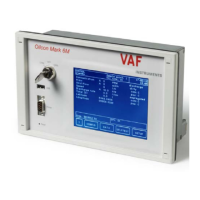
| Model | OILCON MARK 6M |
| Category | Control Systems |
| Language | English |

 To Next Page