72
7.7 SYSTEM OVERRIDES
The MCU provides a number of output signals to allow flexible means of controlling the ballast water
discharge system. Two outputs are under the direct control of the MCU and these are used to
automatically control the discharge system: to stop the discharge when the alarm points are
reached and to permit discharge when the discharge rate of oil is within limits. Overriding of the
MCU should only be considered if the MCU itself has failed or if special circumstances prevail.
There may be occasions when it is imperative to override the control signal from the MCU to the
ballast discharge system, if automatic control is fitted. The control switch on the MCU front panel
has a position marked “Console” with the switch in this position the automatic control is overridden,
which means that the control of the valves, pumps etc. in the ballast discharge system has reverted
to the cargo control room console. In the position marked “Control Unit”, control of the ballast
discharge system is entirely from the MCU. The fact that the switch has been operated will be
recorded.
7.7.1 Transducer override
On occasions, one of the three transducers in the system (Oilcon
®
Oil Discharge Monitoring and
Control System, ship’s log or discharge flowmeter) may be defective. For this situation, the input of
these transducers can be changed from Auto to Manual. This can be done by entering the setup
mode or the idle setup mode and selecting the required input signal. The input mode is indicated
alongside the input by “A” for automatic and by a value for manual.
Any of the 3 inputs and any combination of these inputs can be set to manual. Any change of mode
from automatic to manual or vice-versa will be recorded.
7.7.2 Discharge control
The main purpose of the MCU is to control the discharge of ballast water overboard. The MCU
controls an internal relay which, when suitably connected, can be used to open or close an
overboard valve, or start and stop a cargo pump. The specific installation on any ship may vary.
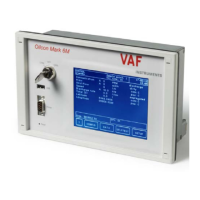
Figure 62
The position of this internal relay is shown on the display on the screen and is either “O” (open) or
“C” (closed). The relay will be closed when:
the Oil Discharge Monitor is switched off or is self-flushing
when the discharge rate exceeds 30 l/NM
when the total oil discharged exceeds 1/30,000 of the last cargo carried
should there be any other alarm displayed on the MCU
When the monitor has completed the Flush cycle and has switched to sample, there will be a 10 s
delay before the valve position changes to open. If the discharge is being restarted after an alarm
condition, then there will be a 2 min delay after the alarm has been cleared before the valve position
changes to “O” (open).
CONTROL Sample point: 1 22-11-11
sample Oil type: 5 10:38
Concentration A 200 PPM discharge
Flow A 165 m3/h dirty
Skid Flow 0 l/h com: O
Speed A 10.0 kts pos: O
Discharge rate 3.3 l/nm segregated
Total oil 2.1 l com: C
Latitude 5321.756N pos: C
Longitude 00711.854E
EPU: OK
free: 1927296 kB
MORE? CHANGESELFTEST


 To Next Page