34
6.7.3 Starting interlock and/or overboard valve control
IMO Resolution MEPC 108 (49) entitled:
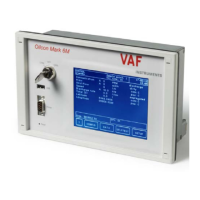
“Guidelines and specifications for Oilcon
®
Oil Discharge Monitoring and Control Systems for
tankers”
Oil tankers of 150 gross tonnage and above shall be fitted with an Oilcon
®
Oil Discharge Monitoring
control system approved by the Administration and designed and installed in compliance with the
Guidelines and Specifications for Oil Discharge Monitoring and Control Systems for Oil Tankers
adopted by the Organization.
System should record and display the necessary information:
Input information: Ship’s position (GPS)
Ship’s speed
Overboard discharge valve position
Oil content [ppm]
Flowrate discharge
Time and date
Starting interlock
Output information: Time and date (UTC)
Ship’s position (GPS)
Auto/manual mode
Status of operational mode
Instantaneous oil content [ppm]
Flowrate of discharge [m³/h]
Ship’s speed [kts]
Instantaneous rate of discharge of oil [l/NM]
Total quantity of oil discharged [l]
Status of discharge
Sample point selected
Type of oil
The data is displayed on a LCD display and also stored in the internal memory
Due to the wide variety of starting interlock and overboard discharge control circuits VAF
Instruments can only give a general concept of how they can be achieved.
Firstly: the IMO description of each version and then an interpretation of the system layout using the
Oilcon
®
Oil Discharge Monitoring and Control System.
i) Discharge valve control
The definition of an overboard discharge control is given in paragraph 3.3 of the Annex to IMO
Resolution MEPC 108 (49) and is as follows:
“An overboard discharge control is a device which automatically initiates the sequence to stop the
overboard discharge of the effluent in alarm conditions and prevents the discharge throughout the
period the alarm condition prevails. The device may be arranged to close the overboard valves or to
stop the relevant pumps, as appropriate.”


 To Next Page