8
2 PRODUCT DESCRIPTION
The Oilcon
®
Oil Discharge Monitoring and Control System continuously samples ballast water being
discharged overboard and measures the oil content and controls the discharge of the ballast water
and plays therefore a central role in the Oil Discharge Monitor and Control System.
A schematic arrangement of the entire Oilcon
®
Oil Discharge Monitoring and Control System is
shown in drawing 0806-8035.
2.1 PRINCIPLE OF OPERATION
The measurement technique used in the Oilcon
®
Oil Discharge Monitoring and Control System is
based on scattered light. The sample of discharge water passes through a detector cell while light
enters and leaves the measurement area of the cell. The sample flow is at right angles to the optical
path. When no particles or oil droplets are present in the water, light can pass straight through the
cell (Direct beam). When oil is present in the form of a homogeneous mixture, light is scattered at
different angles (Scatter beam). The intensity of scattered light at a specific angle depends on the
density of oil droplets and their particle size relative to the wavelength of radiation. The intensity of
light of the direct beam decreases logarithmically with an increasing oil concentration, while the
scatter beam increases linearly but passes through a maximum before decreasing logarithmically.
The maximum occurs because of the increase in attenuation blocking out the scattered light at high
concentrations. The variation of light refraction by oil droplets only is quite different to that refracted
when solid contaminants are also present and this fact can be used to obtain an accurate indication
of oil content whilst disregarding solid particles up to a point.
The light source used in the Oilcon
®
Oil Discharge Monitoring and Control System is a near infra red
diode which is operated in a pulsed mode so that the average power dissipation is very low,
although the intensity is high. The light signal is processed and transmitted along a signal cable
from the detector cell to the EPU where the three detection signals are used to compute the oil
concentration levels present in the sample passing through the detector cell.
The response in the optical detection is instantaneous and most of the delays when reading oil
levels lie in the sampling pipework. High velocity, short sampling length and minimum pipework
bends give fast response times. During periods of inactivity the pipework may become fouled and
when the system is started up, erroneous readings could occur as oil is stripped from the pipework.
Automatic sequential control of forward and backward flushing at start up and shut down of the
monitor prevents erroneous readings and keeps the sampling lines clean. This also ensures reliable
start up, minimises system deterioration and ensures that the pipework is left in clean condition prior
to the next use of the monitor. At the end of the start up flushing cycle a system zero check is
performed, this automatic zero setting compensates for any small deposits on the cell windows. The
window wash pump cleans the cell windows at regular intervals.
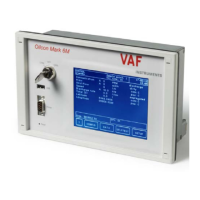
All operating controls and system alarms are situated on the MCU. Manual system flush and
window wash controls are available to make these two operations possible at any time. With the
exception of selecting the sample point and the oil type, the system works automatically once
sampling has been initiated. The oil level together with the discharge flow rate and ships speed are
input to the MCU to give a permanent record of oil discharged overboard. Both calibration alarms
and operational alarms are provided and the alarm philosophy employed follows normal marine
practice. When a fault occurs, both audible and visual alarms are activated. The audible alarm can
be silenced by fault acceptance but the visual alarm cannot be extinguished. It is only after the fault
has been rectified that the visual alarm is extinguished. Should a second alarm occur during this
sequence, both audible and the visual alarms would be reactivated.


 To Next Page