Need help?
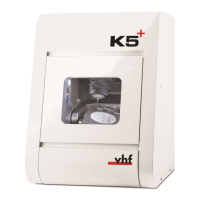
Do you have a question about the VHF K5+ and is the answer not in the manual?
Information about the document's purpose and target audience.
Explanation of symbols used in the instructions for clarity.
Details on how safety information is presented and signal words used.
Warnings and guidelines for safe machine operation.
Hazards associated with electrical components and water.
Risks from harmful materials, dust, and ionizer emissions.
Dangers from moving axes and spindle.
Precautions against tripping and slipping in the work area.
Hazards from touching sharp edges or hot parts.
Impact of poor lighting on judgment and precision.
Consequences of neglecting machine maintenance.
Ergonomic considerations for user health.
Hazards associated with opening/closing the chamber door.
Specifies the intended use and limitations of the machine and software.
How to control the machine using dedicated applications.
Importance of regular maintenance for machine longevity.
Information about the high-precision spindle and its handling.
Conditions and risks associated with unattended operation.
Guidelines for safe transport, storage, and repackaging.
Identification of components on the front of the machine.
Details of the machine's connection ports.
Description of the working chamber door and its operation.
Overview of the working chamber, its components, and lighting status indicators.
Location and purpose of the accessories container.
Explanation of the system designed to reduce soiling and wear.
Requirements for the computer and software used to operate the machine.
Information on sound levels during operation and measurement conditions.
Where to find the machine's identification plate and serial number.
Description of the machine's linear and rotary axes.
Detailed technical specifications of the machine.
List of items included in the machine delivery and how to check them.
Criteria for selecting a suitable installation location and required distances.
Diagram illustrating the machine installation and connections.
Instructions for connecting the machine to the power supply.
Steps to remove the transport lock before initial operation.
Guidelines for installing the pneumatic system and air supply.
Description and connections of the compressed air regulator.
Steps for connecting the pneumatic hose.
How to set and monitor the air pressure using the regulator.
Overview of components and requirements for the air extraction system.
Specific properties required for the suction unit.
Steps for installing the suction unit.
Instructions for connecting the suction hose using an optional connection.
Procedure for installing the optional switching unit for automatic suction control.
How to connect the machine to the network and send commands.
Detailed steps for configuring SX Virtual Link and DENTALCNC.
Steps to configure the machine's webcam in DENTALCNC.
Tips for network connection, device usage, and troubleshooting.
How to manage device access when multiple computers use SX Virtual Link.
Troubleshooting steps if the machine cannot be accessed over the network.
Using the machine's web server for network setup and diagnostics.
How to reset network settings to default configurations.
Step-by-step guide to starting the machine and ensuring readiness.
Procedure to safely start the machine when a tool is already in the spindle.
Instructions for safely powering down the machine.
Information on the types of blanks and how to mount them.
Detailed steps for mounting discs into the blank holder.
Instructions on how to mount blocks onto the block holder.
Steps to install the block holder into the machine's working chamber.
Information on using an optional holder for prefabricated abutments.
Guidelines for handling and managing tools, including warnings about improper tools.
Procedures for inserting new tools and exchanging worn ones.
How to enable or disable the ionizer using DENTALCNC.
Prerequisites and steps for starting a machining job.
Procedures for stopping a machining job prematurely.
Reasons for job interruptions and abortions, and how to proceed.
Steps to take when a job is interrupted due to insufficient air or vacuum.
Procedures to follow in case of a critical machine malfunction.
Steps to take when a tool breaks during machining.
Actions to take after a power failure, including emergency opening.
Instructions for performing an emergency opening of the chamber door.
Overview of the maintenance tasks available in DENTALCNC.
Routine maintenance tasks requiring minimal skills.
Information on scheduled preventive maintenance.
Contact information for customer service and service appointments.
Explanation of wear parts, warranty, and useful life.
Detailed procedure for cleaning the working chamber and its components.
Additional cleaning tasks, including webcam and view window.
Steps for cleaning the collet chuck using the spindle service set.
How to check the compressed air regulator for contamination.
Procedure to check the water separator for condensate.
Steps to exchange or clean the filter cartridge in the water separator.
Guidelines for cleaning the machine housing without causing damage.
Procedure for replacing the main fuse.
Information on axis calibration, its risks, and when it's necessary.
Procedure for replacing worn tool magazine inserts.
Steps to replace the blank holder clamping system.
Importance and procedure for updating machine software and firmware.
Methods for updating DENTALCAM and DENTALCNC.
Manual procedure for updating the machine's firmware.
A comprehensive table outlining maintenance tasks, intervals, and procedures.
List of wear parts that users can replace and their recommended intervals.
Wear parts requiring professional exchange by customer service.
Regulations for safely disposing of machining residues.
Procedures and regulations for disposing of the machine itself.
Troubleshooting steps for issues with opening the working chamber door.
Diagnosing issues related to power availability at the installation site.
Checking for electrical power at the installation site.
Troubleshooting a blocked working chamber door.
Solutions for when the machine fails to reference after setup.
Troubleshooting jobs not executing despite computer connection.
Diagnosing and resolving issues with machining quality and tool breakage.
Checking for correct blank mounting to ensure proper machining.
Checking blank holder components for contamination.
Cleaning and checking the measuring key for contamination.
Inspecting tools for wear and checking their life values.
Verifying tool shank rings are correctly positioned.
Checking for wear in tool magazine inserts.
Ensuring job and blank parameters match for correct machining.
Verifying the use of the latest software version.
Checking the quality of CAD/STL files for machining.
Diagnosing issues with the collet chuck's seating or cleanliness.
Checking if the collet chuck has been exchanged within the recommended interval.
Troubleshooting low vacuum issues interrupting jobs.
Checking and adjusting the compressed air regulator settings.
Diagnosing errors originating from the external compressed air supply.
Addressing issues with fluctuating air pressure causing job interruptions.
Checking if the suction unit is correctly powered and functioning.
Checking the suction unit's filter and container for fullness.
Adjusting the tapping interval for the suction unit's automatic function.
Procedure for drilling holes into new tool magazine inserts.
 General
| Brand | VHF |
|---|---|
| Model | K5+ |
| Category | Dental equipment |
| Language | English |

 To Next Page