Measuring Light at the Photodiode 49
4
4. After all of the diodes have been recharged and read (11 msec), the detector
waits 39 msec before beginning the recharge-and-reading sequence with
diode 1.
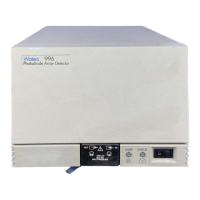
You set the exposure time parameter in the General tab of the 996 PDA Instrument
Method Editor. You can specify either Auto Exposure or Exposure Time. For details, refer
to the “Waters 996 PDA Detector Properties” topic in the
Millennium
32
Online Help
Find
tab.
Using the Auto Exposure Parameter
The Auto Exposure time parameter allows the 996 detector optics to calculate the
optimum exposure time needed to recharge the diodes based on lamp energy, lamp
spectrum, mobile phase absorbance, and the chosen wavelength range. To minimize
detector noise, Auto Exposure adjusts the exposure time to 80 to 90 percent of full scale.
The Auto Exposure time setting ensures that the photodiodes are:
• Not saturating due to overexposure
• Operating above the range of normal, dark current discharge
With auto exposure enabled, the 996 detector:
• Calculates exposure time at the start of a run based on maximum light intensity
within the wavelength range
• Limits the exposure so that no diode within the given wavelength range is
discharged more than 80%
• Provides proper settings for signal-to-noise and dynamic range for each run
The Auto Exposure time setting may not support certain sampling rates or wavelength
ranges required for your analysis. If this is the case, you can set the exposure time
manually to adjust the exposure time from experiment to experiment.
Using the Exposure Time Parameter
The Exposure Time parameter enables you to manually set the length of time the
photodiodes are exposed to light before they are read. The supported range is 11 to
500 msec.
Be aware that increasing the Exposure Time parameter has the potential to saturate the
photodiodes. A longer exposure time may cause the 996 detector to lose the signal at
certain wavelengths because of diode saturation. When specifying the Exposure Time,
select a value that provides settings for an optimum signal-to-noise ratio over the
wavelength range of your analysis (see “
Optimizing the Signal-to-Noise Ratio” below).


 To Next Page