Chapter 1 Get Started
About Relative Standard Curve and Comparative C
T
Experiments
11
Applied Biosystems 7500/7500 Fast Real-Time PCR System Getting Started Guide for Relative Standard Curve
and Comparative C
T
Experiments
Notes
Supported
Reagents
Taq Man
®
and SYBR
®
Green Reagents
Applied Biosystems offers TaqMan
®
and SYBR
®
Green reagents for use on the
7500/7500 Fast system. Both reagent types are briefly described in the table below.
Note: If you use TaqMan
®
or SYBR
®
Green reagents, the 7500 software automatically
calculates reaction volumes in the Reaction Setup screen.
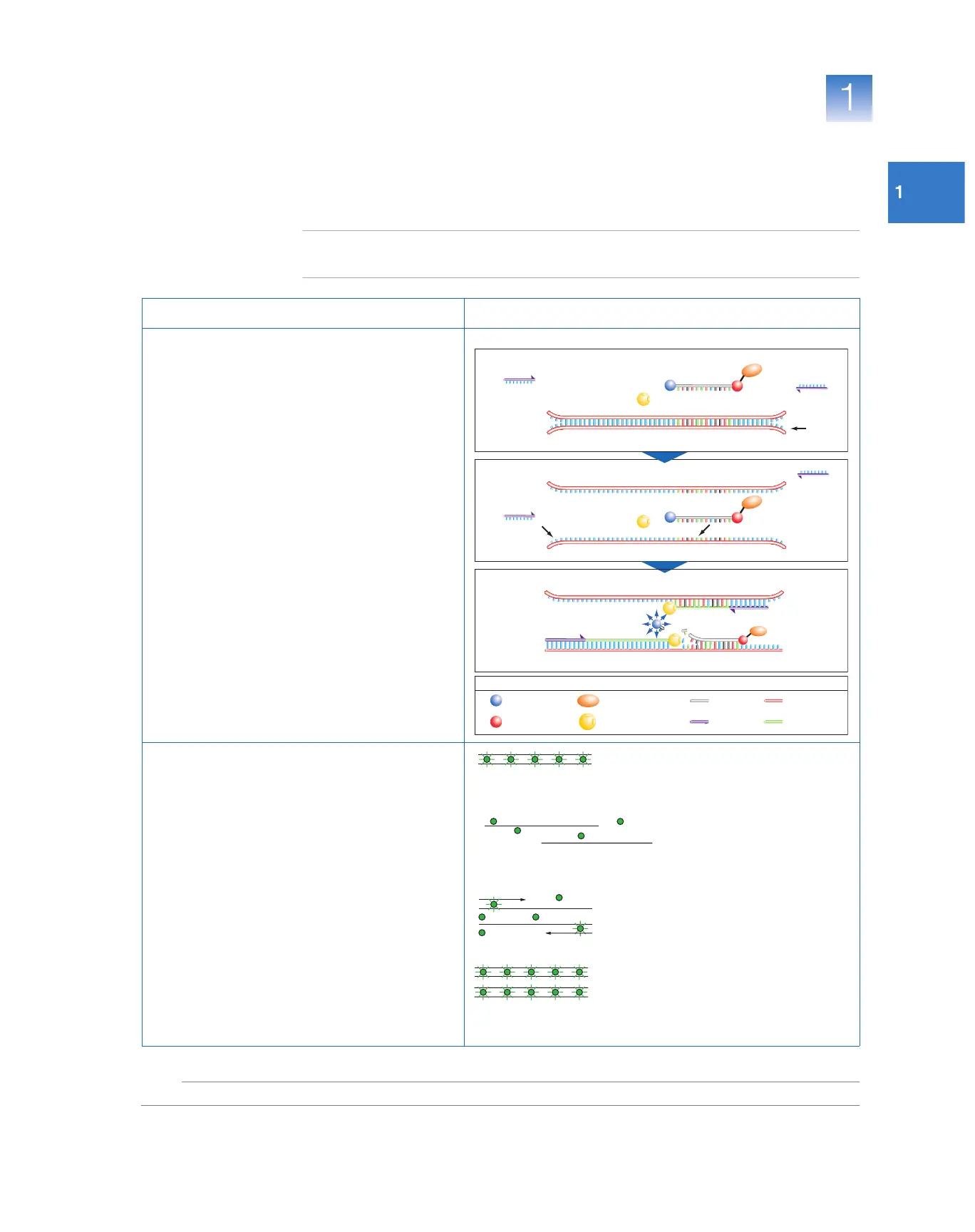
Reagent Type Process
Taq M a n
®
reagents or kits
Description
TaqMan reagents use a fluorogenic probe to enable
detection of a specific PCR product as it accumulates
during PCR cycles.
Advantages
• Increased specificity with the addition of a
fluorogenic probe.
• Provides multiplex capability.
• Preformulated assays, optimized to run under
universal thermal cycling conditions, are available.
• Can be used for either 1- or 2-step RT-PCR.
Limitations
Requires synthesis of a unique fluorogenic probe.
SYBR
®
Green reagents
Description
SYBR Green reagents use SYBR
®
Green I dye, a
double-stranded DNA binding dye, to detect PCR
products as they accumulate during PCR cycles.
Advantages
• Economical (no probe needed).
• Allows for melt curve analysis to measure the Tm
of all PCR products.
• Can be used for either 1- or 2-step RT-PCR.
Limitations
Binds nonspecifically to all double-stranded DNA
sequences. To avoid false-positive signals, check for
nonspecific product formation using melt curve or gel
analysis.
b. Denatured Template and Annealing of Assay Components
Forward primer
Reverse primer
Q
MGBF
LEGEND
FAM™ dye
Probe
5'3'
a. Assay Components
cDNA Template
Forward primer
Reverse primer
Probe
Q
MGB
F
Probe
Q
MGB
F
5'3'
PCR and Detection of cDNA
cDNA
5'3'
5'3'
c. Signal Generation
Reverse primer
F
Forward primer
5'3'
3'5'
5'3'
MGB
Q
Minor Groove
Binder
Template
AmpliTaq Gold
®
DNA Polymerase
Quencher
Primer
Extended Primer
FORWARD
PRIMER
REVERSE
PRIMER
Step 1: Reaction setup
The SYBR
®
Green I dye
fluoresces when bound to
double-stranded DNA.
Step 2: Denaturation
When the DNA is denatured into
single-stranded DNA, the
®
SYBR Green I dye is released and
the fluorescence is drastically reduced.
Step 3: Polymerization
During extension, primers
anneal and PCR product
is generated.
Step 4: Polymerization completed
SYBR
®
Green I dye binds to the
double-stranded product,
resulting in a net increase in
fluorescence detected by the
instrument.


 To Next Page