36
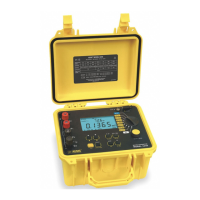
Micro-Ohmmeter Model 6250
The compensated resistance level is expressed as follows:
R(T
ref
) = R(T
amb
) * (1 + alpha * T
ref
)
1 + (alpha * T
amb
)
Where:
R(T
amb
) = the resistance value measured at ambient temperature
T
amb
= the temperature measured by a Pt100 probe or programmed
by the operator
Alpha = the temperature coecient of the chosen metal (Aluminum,
Copper, “Other metal”)
T
ref
= the programmed reference temperature to which the
measurement is compensated to
The Temperature Coecient of Copper (near room temperature) is +0.393
percent per degree C. This means if the temperature increases 1°C the
resistance will increase 0.393%.
Example: You have 100 feet of 20 gage wire and its resistance is 1.015Ω at
20°C (room temp). If the temperature of the wire goes up 10°C the resistance
will change by 0.0399Ω (10° * 0.00393 / ° * 1.015Ω = 0.0399Ω).
The wire resistance will now be 1.015
Ω + 0.0399Ω = 1.0549Ω.
The table below provides the temperature coecients of the more common
metals and alloys.
The Alpha values for Copper and Aluminum are pre-programmed into the
Model 6250. Others may be programmed by selecting Other Metals and
then programming in the alpha constant from the table or other sources.
Material Element/Alloy
“alpha” per °C
X10
-3
Aluminum Element 4.030
Copper Element 3.930
Nickel Element 5.866
Iron Element 5.671
Molybdenum Element 4.579
Tungsten Element 4.403
Silver Element 3.819
Platinum Element 3.729
Gold Element 3.715
Zinc Element 0.847
Steel Alloy 3.000
Nichrome Alloy 0.170
Nichrome V Alloy 0.130
Table 2
w ww . . co m
information@itm.com1.800.561.8187


 To Next Page