Service Brake See page 49 for brake schematic.
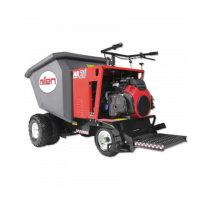
Inspect the Service Brake DAILY. A daily Service Brake inspection performed with an empty buggy
traveling at full speed must demonstrate that when full foot pressure (125 LB.) is applied to the brake
pedal both brakes engage equally, the pedal is level with the top of the operator’s platform, the buggy
stops in 6-8’ of travel and the engine stalls.
3.1 - Brake Service
Brake Operational Problem Adjustment/Repair Required Adjustment/Repair Procedure
1) Brake pedal (44) travels
below operator’s platform
before brake engages.
Tighten brake bands.
1) Turn nut (16) clockwise. Use 3/4”
deep well socket. Turn nuts for both
brakes in increments of ¼ turn until
brake pedal activates brake at the
top of operator’s platform. Verify
both brakes engage at the same
time by running buggy, applying
brake and having an observer verify
both brakes lock up together.
2) If after making adjustment in
#1 above, the pedal is still below
operator’s platform when the ser-
vice brake is engaged, shorten the
distance of the (2) clevis’, item 34.
Reattach clevis pins with NEW 1/8”
x 3/4” long cotter pins.
2) One brake engages before
other brake.
Tighten brake band on brake
that engages late.
Turn nut (16) clockwise on brake
that engages late in increments of
¼ turn until both brakes activate
together. Verify brake operation with
an observer (see 1 above).
3) Brakes screech when
applied.
1) Clean concrete/dirt /oil
accumulation away from brake
bands.
2) Replace worn brake
bands(s) (brass rivets are
contacting brake drum and/
or brake lining worn less than
1/8” thick).
Remove four (4) front wheels. Re-
move two (2) brake covers and
brake band(s) and clean. Replace
brake bands if required and readjust
brakes per above.
SECTION 3
SERVICE
055838 Page 46



 To Next Page