IS-200A
4. How to Operate Screens
4-17
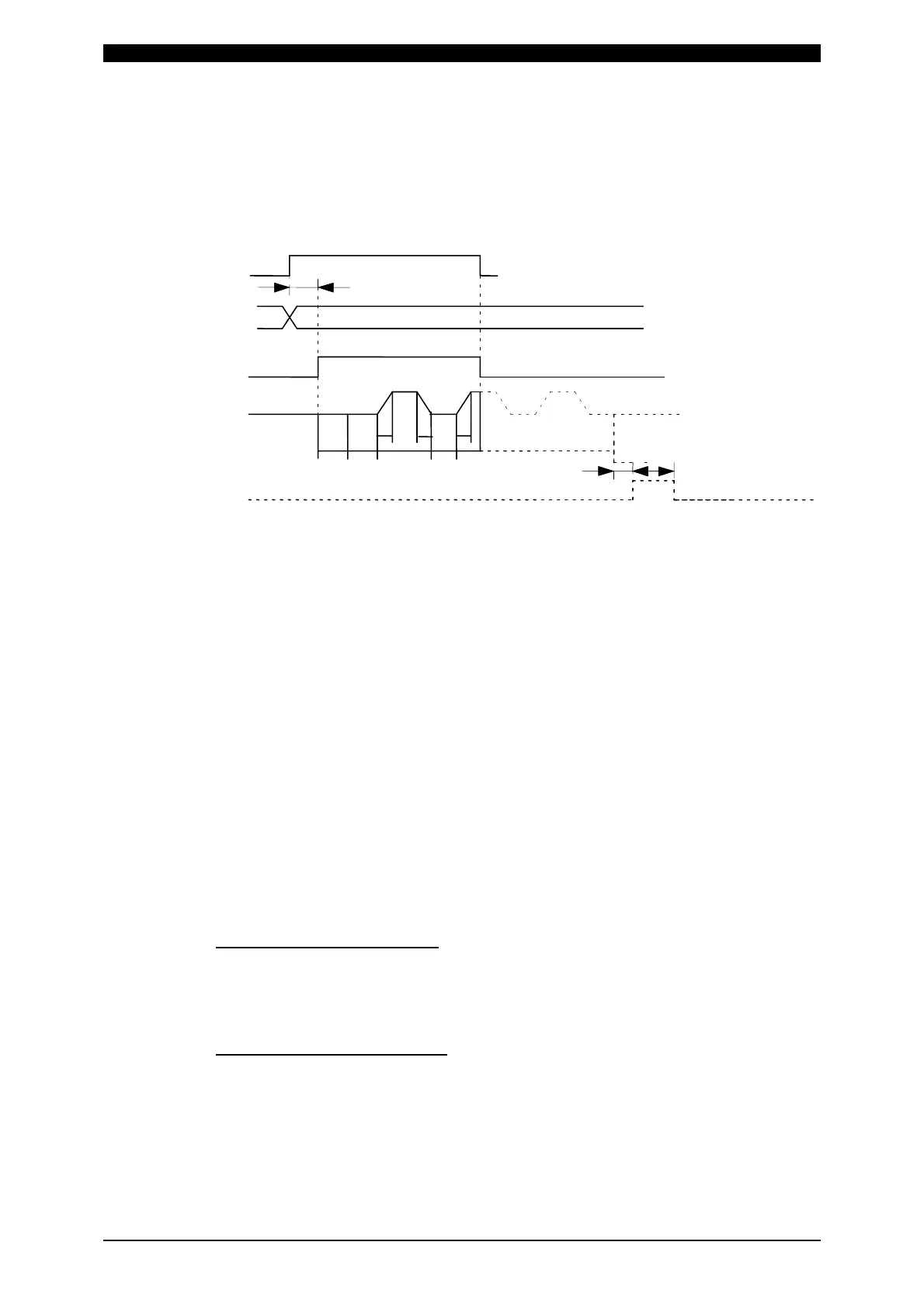
3) MAINTAINED
If the 2ND STAGE signal stops halfway through the welding sequence (from
the beginning of initial squeeze delay time through the end of hold time), the
welding sequence will halt at that point.
Note that the end signal will not be output at this time.
A
2ND STAGE
(1,2,4,8,16
32,64,128,P)
A: DELAY START SET
B
C
END si
nal output
no output if the weldin
sequence is halted
Schedule
selection
Weldin
sequence
B: Monitored value
ud
ment
time
C: END si
nal output
time
alve output
SOL1 or SOL2
SQD SQZ
U U D
WE1 CO1
(c) END SIG.TIME
Set the length of time for output of the end signal. The output time can be set in
a range from 10 to 200
ms and in units of 10 ms. The start signal is not received
while the end signal is output.
(d) END SIG.MODE
Set the conditions for output of the end signal upon completion of the weld
sequence.
0: Outputs the end signal even when the monitored value is outside the upper
and lower tolerance limits. The end signal will not be output in the event of a
no-current or overcurrent error.
1: The end signal will not be output if the monitored value is outside the upper
and lower tolerance limits or in the event of a no-current or overcurrent error.
2: The end signal will be output even when the monitored value is outside the
upper and lower tolerance limits and even in the event of a no-current or
overcurrent error.
(e) PARITY CHECK
Select whether or not parity check is performed. (Set external input pin 13.)
When PARITY CHECK = ON
Parity check will be performed. This check allows for detection of a failure
resulting from a wire break in the schedule selection signal lines. Be sure that
the total number of closed schedule selection and parity signal lines is always
odd. (Refer to Note 1, “Schedule Nos. and Schedule Selection Pins.”)
When PARITY CHECK = OFF
Parity check will not be performed. (The terminal functions as the WE1STOP
terminal.) The sequence will proceed to COOL1 if external input pin 13 is closed
during the WE1 sequence operation. (Refer to Note 2, “Current shutoff
function.”)



 To Next Page