Section 3 MS2667C
3-2
3.1 Overall Circuit description
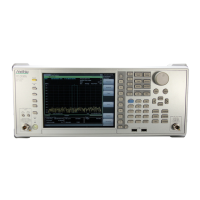
MS2667C is a superheterodyne system scanning-type spectrum analyzer.
This section describes overall circuit of the MS2667C spectrum analyzer with its block diagram.
An RF input signal after passing through an RF switch and variable RF ATTN in Switched Attenuator is switched by
Diplexing Bandswitch to two different signal routes depending on input RF frequency.
For an RF input frequency of 9 kHz to 3.1 GHz (termed as band 0), the signal passes through 3.2 GHz LPF and then to 1st
mixer (1st MIX), where it is mixed with 1st local signal (4.1 GHz to 7.2 GHz) to generate 4110.69 MHz 1st IF signal.
The 1st IF signal is then passed through an amplifier and image rejection filters, and fed to 2nd mixer (2nd MIX), where it
is mixed with 4 GHz 2nd local signal to generate 110.690 MHz 2nd IF signal.
For an RF input frequency of 3.1 GHz to 30 GHz (band 1 to 5), the signal goes to YTF (YIG tuned filter), and then to 30
GHz H.MIXER. In 30 GHz H.MIXER, the RF signal gets mixed with the 1st local signal (3.6 GHz to 7.5 GHz) to generate
689.31 MHz 1st IF signal.
This 1st IF signal is passed through a series of amplifiers and image rejection filters before further mixing with 800 MHz
2nd local signal to convert the signal to the 110.690 MHz 2nd IF signal.
Depending on the active band of RF input, one of the two above 2nd IF signal is sent to IF section for further processing.
The 1st local signal generated at YTO (YIG tuned oscillator) is frequency-swept by scan signal from SCAN/AD section
after phase-lock to reference signal (its frequency is 11 MHz to 14 MHz with the resolution of 1 Hz steps) generated on
LOCAL-SP1, 2 section at the center frequency of its sweeping range, in normal sweep condition.
The YTO output is passed through an amplifier, and then divided into three paths with directional couplers. One of divided
signal is fed to sampler circuit and the other are fed to the above mixers to frequency-convert.
In the sampler circuit, sampling signal (its frequency is 94 MHz to 106 MHz with the resolution of 1 MHz steps) generated
on LOCAL-SP1, 2 section is frequency-multiplied, and then mixed with the YTO output to generate sampler IF signal with
a frequency of 11 MHz to 14 MHz.
The sampler IF signal is compared with the reference signal of 11 MHz to 14 MHz at PFD.
The reference signal frequency (fREF) and the sampling signal frequency (fs) are controlled by CPU section according to
the measuring frequency of the instrument, and set so that the center frequency of 1st local signal is fs * N ± fREF (, where
N is an integer).
Meanwhile, the scan signal strength that is equivalent to frequency sweep width is controlled from LOCAL-SP1, 2 section.
The 2nd local signals of 4 GHz and 800 MHz are also phase-locked to 100 MHz VCXO signal, of which the frequency is
also phase-locked to 10 MHz crystal oscillator.
In the instrument, a high accuracy 625 kHz signal is present for level accuracy calibration. This signal is generated by
frequency-dividing the 10 MHz reference signal, and its power level is varied with 1 dB steps by CAL ATT.
Internal calibration operation being carried out, this calibrating signal is fed to the RF signal-route through the switch in
Switched Attenuator.






 To Next Page