12
THE INFORMATION CONTAINED HEREIN IS PROPRIETARY TO APPLANIX CORPORATION. RELEASE TO THIRD PARTIES OF THIS PUBLICATION OR OF
INFORMATION CONTAINED HEREIN IS PROHIBITED WITHOUT THE PRIOR WRITTEN CONSENT OF APPLANIX CORPORATION. APPLANIX RESERVES THE
RIGHT TO CHANGE THE SPECIFICATIONS AND INFORMATION IN THIS DOCUMENT WITHOUT NOTICE. A RECORD OF THE CHANGES MADE TO THIS
DOCUMENT IS CONTAINED IN THE REVISION HISTORY SHEET. COPYRIGHT © APPLANIX CORPORATION, 2021ALL RIGHTS RESERVED. NO PART OF
THIS PUBLICATION MAY BE REPRODUCED, STORED IN A RETRIEVAL SYSTEM OR TRANSMITTED IN ANY FORM OR BY ANY MEANS WITHOUT THE
PRIOR WRITTEN CONSENT OF APPLANIX CORPORATION.
The LVX is designed to support a wide variety of GNSS antenna elements. GNSS band
coverage will be dictated by the bandwidth of the chosen antenna. The unit is capable of
supporting antenna elements with a minimum LNA gain of 32dB.
The recommended antenna electrical specifications are outlined below:
Frequency: 1565.5 to 1614 MHz
1217 to 1257 MHz
VSWR: 2.0 max.
Bandwidth: 60 MHz min.
Impedance: 50Ω
Peak Gain: 4dBic min.
Amplifier Gain* (without cable loss) +32 to +41 dB typical
Noise Figure: 1.5 dB typical
Output VSWR: 1.5:1 typical
Filtering: -30dB (±100 MHz)
DC Voltage: +5 to +7.5V dc
DC Current: 300mA max
* Required LNA Gain does not account for Antenna cable insertion loss.
The antenna choice is subject to the particular platform the LVX is being used on.
Special care of antenna placement must be taken during integration of the system to
minimize the impact of possible interferences. Failure to do so will result in the system
not meeting its specification.
3.3.2. Power / IO Connector
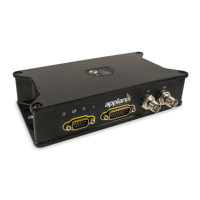
The power/IO connector used on LVX is a rugged DE 26 male connector made by
Amphenol, part number MDBR-A26PE-860.
The connector pin-out is shown below in Figure 12.
3.3.1. PPS and Event In
The PPS (Pulse per Second, pin 20) is the signal that indicates the integer epoch of
UTC/GPS time. It is a TTL 3.3V pulse active high with maximum current of 4mA.
The Event In 1 and 2 (pins 3 and 4) are the time markers of an external pulse. They are
used to capture the exact time of the external event initiated by a sensor (usually a
camera).
Event inputs can tolerate 3.3V or 5V TTL.


 To Next Page