39
THE INFORMATION CONTAINED HEREIN IS PROPRIETARY TO APPLANIX CORPORATION. RELEASE TO THIRD PARTIES OF THIS PUBLICATION OR OF
INFORMATION CONTAINED HEREIN IS PROHIBITED WITHOUT THE PRIOR WRITTEN CONSENT OF APPLANIX CORPORATION. APPLANIX RESERVES THE
RIGHT TO CHANGE THE SPECIFICATIONS AND INFORMATION IN THIS DOCUMENT WITHOUT NOTICE. A RECORD OF THE CHANGES MADE TO THIS
DOCUMENT IS CONTAINED IN THE REVISION HISTORY SHEET. COPYRIGHT © APPLANIX CORPORATION, 2021ALL RIGHTS RESERVED. NO PART OF
THIS PUBLICATION MAY BE REPRODUCED, STORED IN A RETRIEVAL SYSTEM OR TRANSMITTED IN ANY FORM OR BY ANY MEANS WITHOUT THE
PRIOR WRITTEN CONSENT OF APPLANIX CORPORATION.
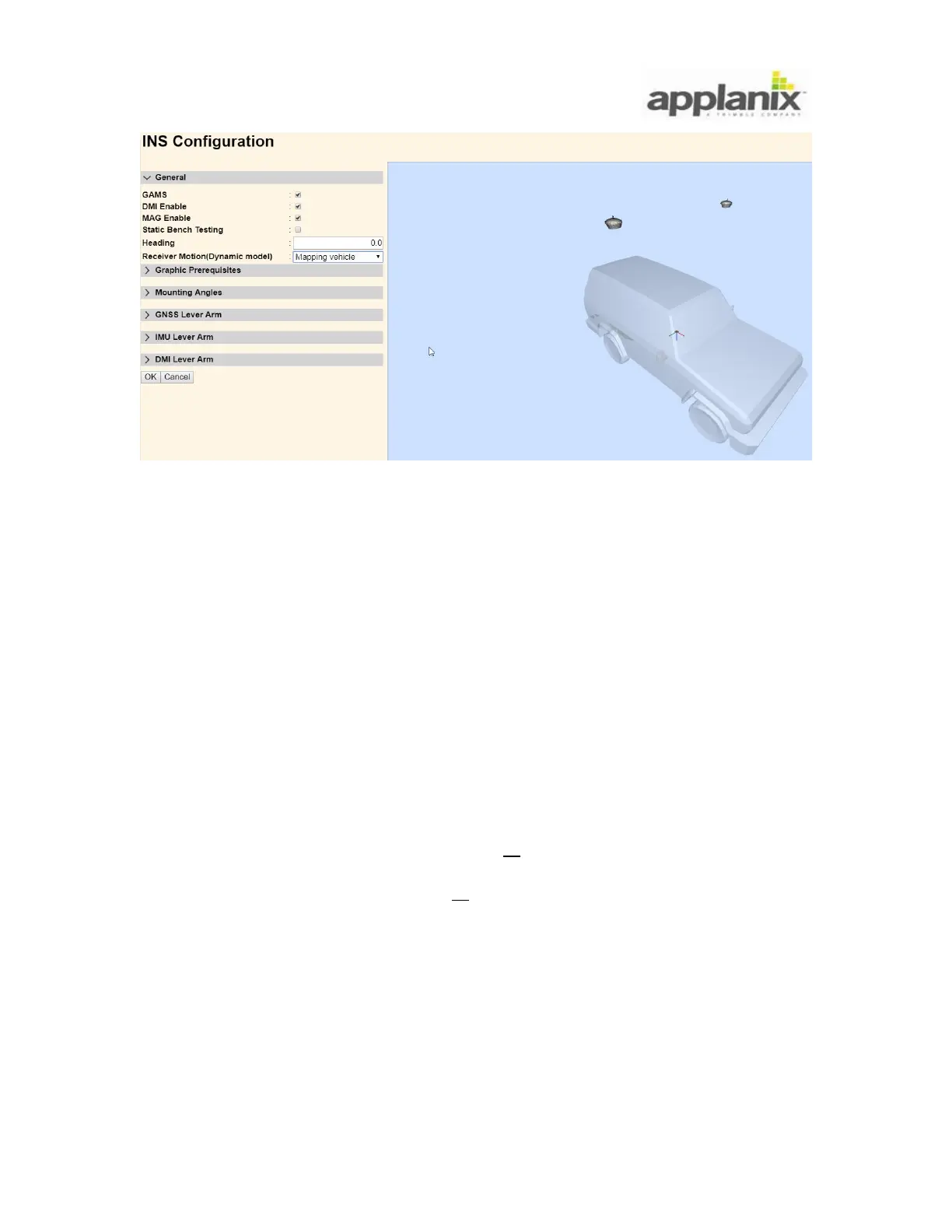
Figure 37: INS Configuration
For testing the system in the lab while stationary, a Static Bench Mode is provided. This
allows the user to initialize the heading of the LVX manually.
Note: The Static Bench Testing Mode must only be enabled during lab testing when
the system is stationary.
Failure to disable this mode before movement will degrade performance!
After entering the Lever Arms and Mounting Angle settings you will be prompted to
reboot the system in order to apply the changes to software.
4.6.12. DMI Scale Factor Calculation
The DMI measures wheel rotation by generating a fixed number of pulses per wheel
revolution. POS LV converts wheel rotation into distance traveled by multiplying the
DMI pulse count by a scale factor that converts pulses to metres. The following formulas
are used to compute the scale factor:
Pulse and Direction DMI (Type 1): s =
𝑛
𝑑𝜋
Quadrature DMI (Type 2): s =
4𝑛
𝑑𝜋
Where n is the number of DMI pulses per revolution, and d is the Instrumented
Wheel diameter in meters.
Note: The number of DMI pulses per revolution is typically stamped on the DMI
nameplate.


 To Next Page