EasyManua.ls Logo

Argo-Hytos OPCom - User Manual

Argo-Hytos OPCom
69 pages
Print Icon
To Next Page IconTo Next Page
Loading...
Subject to change · V 2.02.20 · EN
Page 1
www.argo-hytos.com
Safety and operating instructions
Read safety and operating instructions before use.
Note: The indicated data only serve to describe the product.
Information regarding the use of this product are only examples and suggestions.
Catalog specifications are no guaranteed features.
The information given does not release the user from his / her own assessments and inspections.
Our products are subject to a process of natural wear and aging.
© All rights are reserved by ARGO-HYTOS GMBH, even in the event of industrial property rights.
Any right of disposal such as copying and distribution rights shall remain with us.
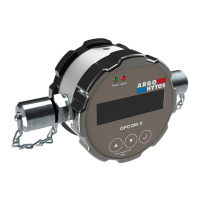
The picture on the title page shows a configuration example. The delivered product may thus differ
from the illustration.
Original instruction
OPCom Particle Monitor
SPCO 300-1000 / 2000 / 1200
Operating Manual

Table of Contents

Other manuals for Argo-Hytos OPCom

Question and Answer IconNeed help?

Do you have a question about the Argo-Hytos OPCom and is the answer not in the manual?

Summary

2. Safety Instructions

2.1 & 2.2 Intended Use

Describes the product's intended purpose and usage guidelines.

2.3 & 2.4 Improper Use & Misuse

Outlines prohibited uses and potential misuse scenarios.

2.5 Personnel Qualification

Specifies the required qualifications for operating the device.

2.6 General safety instructions

Provides general safety guidelines for product operation and handling.

2.7 Product and technology safety

Highlights safety precautions related to the product's technology, e.g., laser.

3. General instructions

7. Assembly

8. Electrical connection

8.1 Pin assignment

Illustrates and explains the pin configuration of the sensor connector.

9. Commissioning

9.1 Before commissioning

Lists essential steps and checks to perform before initial operation.

11. Menu and operation

11.3 Alarm configuration

Covers settings and parameters for device alarms.

11.3.1 Alarm types and settings

Details different alarm types (standard, filter, temp) and their configurations.

11.5 Standard

11.7 Communication

Outlines the available communication interface options.

12. Calibration

12.1 Calibration note

Informs about the necessity of calibration and related notifications.

14. Switching inputs and outputs

15. Communication RS232

15.2 Read commands

Lists commands for retrieving data from the device via RS232.

15.3 Configuration commands

Lists commands for configuring the device via RS232.

16. Communication CAN

16.1.3 Service Data Object (SDO)

Describes SDOs for accessing and modifying object dictionary entries.

16.1.4 Process Data Object (PDO)

Explains PDOs for efficient real-time data transfer.

17. Classification Systems

17.1.1 ISO 4406:17 Classes

Details cleanliness class determination based on ISO 4406:17 standard.

17.1.2 SAE AS 4059 E Classes

Details cleanliness class determination based on SAE AS 4059E standard.

17.1.3 NAS 1638 Classes

Details cleanliness class determination based on NAS 1638 standard.

18. Maintenance and repair

21. Troubleshooting

Error Identification and Resolution

Provides a guide to common errors and their solutions.

23. Technical data

23.1 Technical data table

Presents detailed technical specifications and parameters of the device.

Argo-Hytos OPCom Specifications

General IconGeneral
TemperatureYes
Protection ClassIP67
Output Signal4…20 mA
Power Supply24 VDC
Electrical ConnectionM12 connector
Process ConnectionG1/2"