Subject to change · V 2.02.20 · EN
Page 42
www.argo-hytos.com
16. Communication CAN
The CAN interface meets the „CAN 2.0B Active Specification“.
The sensor supports a limited number of transmission speeds on the CAN-bus.
Data rate Supported CiA Draft 301 Bus length acc. to CiA Draft Standard 301
1 Mbit/s yes yes 25 m
800 kbit/s no yes 50 m
500 kbit/s yes yes 100 m
250 kbit/s yes yes 250 m
125 kbit/s yes yes 500 m
100 kbit/s no no 750 m
50 kbit/s no yes 1000 m
20 kbit/s no yes 2500 m
10 kbit/s no yes 5000 m
16.1 CANopen
The CANopen protocol defines what is described, not the way something is described. With the implemented methods, a distributed
control network is realized which can connect everything, from very simple participants to very complex controllers without causing
communication problems between the participants.
Parameter Size Unit
Typical response time to SDO queries <10 ms
Maximum response time to SDO queries 150 ms
Supply voltage CAN transceiver 3,3 V
Integrated scheduling no -
The central concept of CANopen is the so-called Device Object Dictionary (OD), a concept which is also used in other fieldbus
systems.
The chapters below will first address the Object Dictionary, then the Communication Profile Area (CPA), and finally the CANopen
communication procedure.
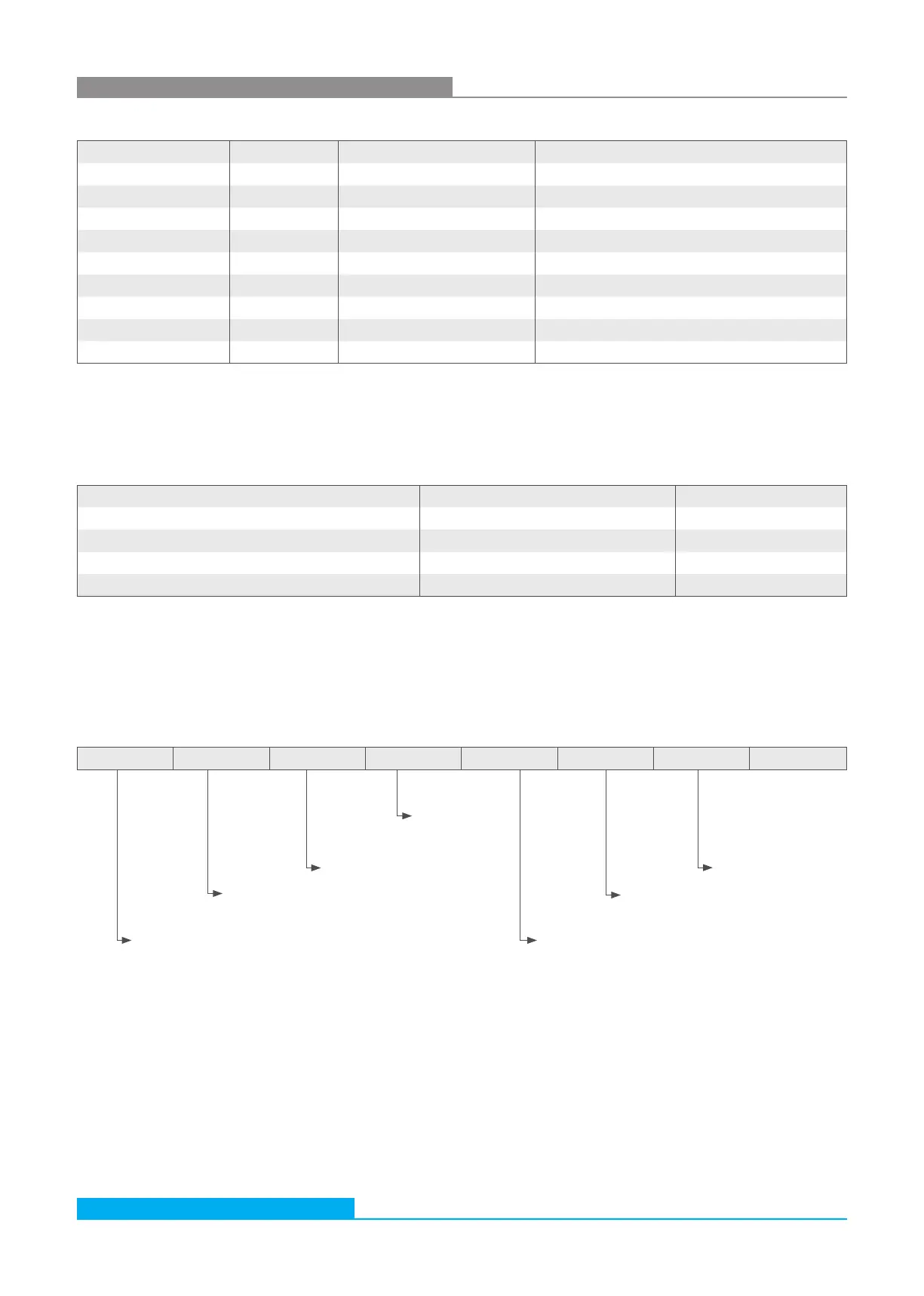
The following figure is for illustrative purposes only, the implementation meets the CAN 2.0B specification.
Start CAN-ID DLC Data CRC ACK END Space
Fig. 25: CANopen message format
Start of message
Address, service type (PDO, SDO, etc.)
Data Length Code
Up to
8 Byte user data
Cyclic Redundancy Checksum
Receiver sets bit to „Low“
End of message
Table 24: Supported bus speeds at CANopen and associated cable lengths
Table 25: Electrical parameter CANopen interface


 To Next Page