♪ While Order offers the most flexibility, random arpeggiation was a signature of ’80s synthpop hits
such as “Rio” by Duran Duran.
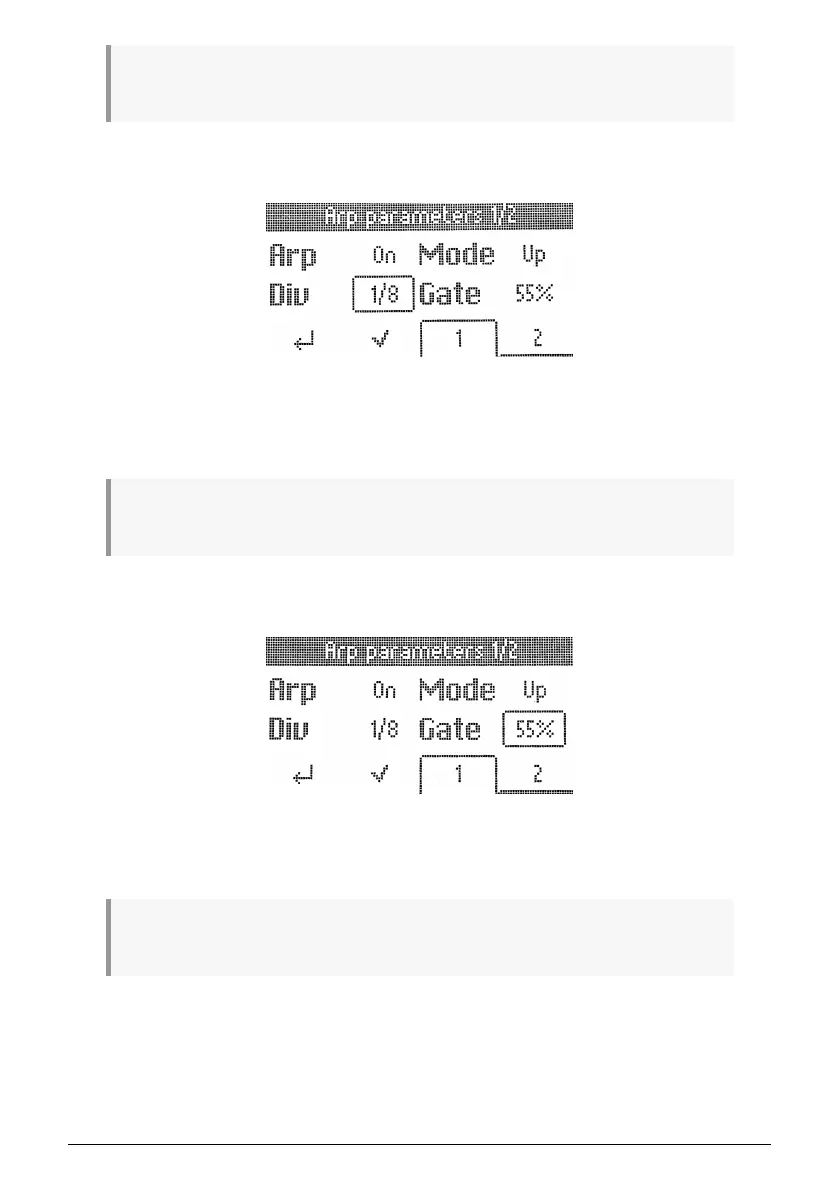
4.12.4.3. Division
This setting controls the rhythmic subdivision of the Arpeggiator relative to master tempo —
whether the tempo source is internal or external. Values include 1/4-, 1/8th-, 16th-, and 32nd-
notes, both “straight” and with triplet feel options. “T” after the displayed value (e.g. “1/8T”)
indicates triplet feel.
! With 1/8 division chosen, even eighth notes are played. With 1/8T, 3 eighth note triplets will play.
This differs from Swing, where a Swing value of 67% will play eighth notes in a triple fashion.
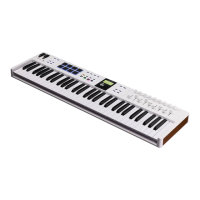
4.12.4.4. Gate
Gate time is the duration window during which each note is allowed to “speak,” and it’s the
same from note to note. Lower gate times result in a more clipped or staccato sound, while
longer gate times give the full envelope of the notes more of a chance to play out.
♪ If the volume envelope of a sound has a long release, reducing the Gate time helps arpeggiated
notes sound more defined.
28 Arturia - User Manual KeyLab Essential mk3 - KeyLab Essential operations


 To Next Page