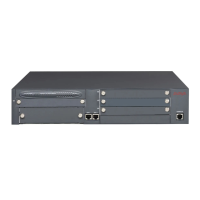
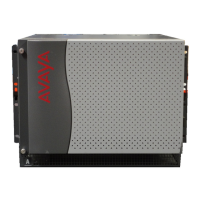
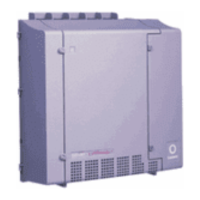
Ground conductor attachments
To assure safe installation and operation, carefully read all requirements, recommendations, and
instructions. Pay special attention to all CAUTION, WARNING, and DANGER statements.
Warning:
System grounding must comply with the general rules for grounding provided in Article 250 of
the National Electrical Code (NEC), National Fire Protection Agency (NFPA) 70, or the
applicable electrical code in the country of installation.
Related links
Installation location on page 34
Ground conductor on page 35
Restricted Access Location on page 35
Ground block on page 35
Approved grounds on page 36
Attaching the ground wires on page 40
Attaching ground wires for purchased ground blocks on page 41
Attaching ground wires for unused ground blocks on page 41
Connecting power to the EM200 expansion modules on page 42
Connecting power to the Branch Gateway on page 42
General grounding requirements
Note:
Grounding requirements differ widely from country to country. In addition to the grounding
instructions presented in this section, you must follow the local electrical installation codes for
your location.
Two safety grounds are required to ensure safe operation of each Branch Gateway and each
EM200: the ground conductor that is part of the AC power cord, and the field-installed green/
yellow conductor referred to as the Supplementary Ground Conductor. Both safety grounds must
be connected to an approved ground. If a power cord accompanies the Branch Gateway or
EM200, use that cord whenever possible.
Installation location
Select a location for the Branch Gateway or EM200 installation that is close enough for use with
the supplied secondary grounding conductor. If this location requirement is not met, contact a
licensed electrician to install a Supplementary Ground Conductor per Article 250 of the National
Electrical Code (NEC).
Installing the Branch Gateway and EM200
July 2018 Deploying and Upgrading Avaya G430 Branch Gateway 34
Comments on this document? infodev@avaya.com



 To Next Page