IFD400 Series Pilot Guide
FMS Subsystem 2-29
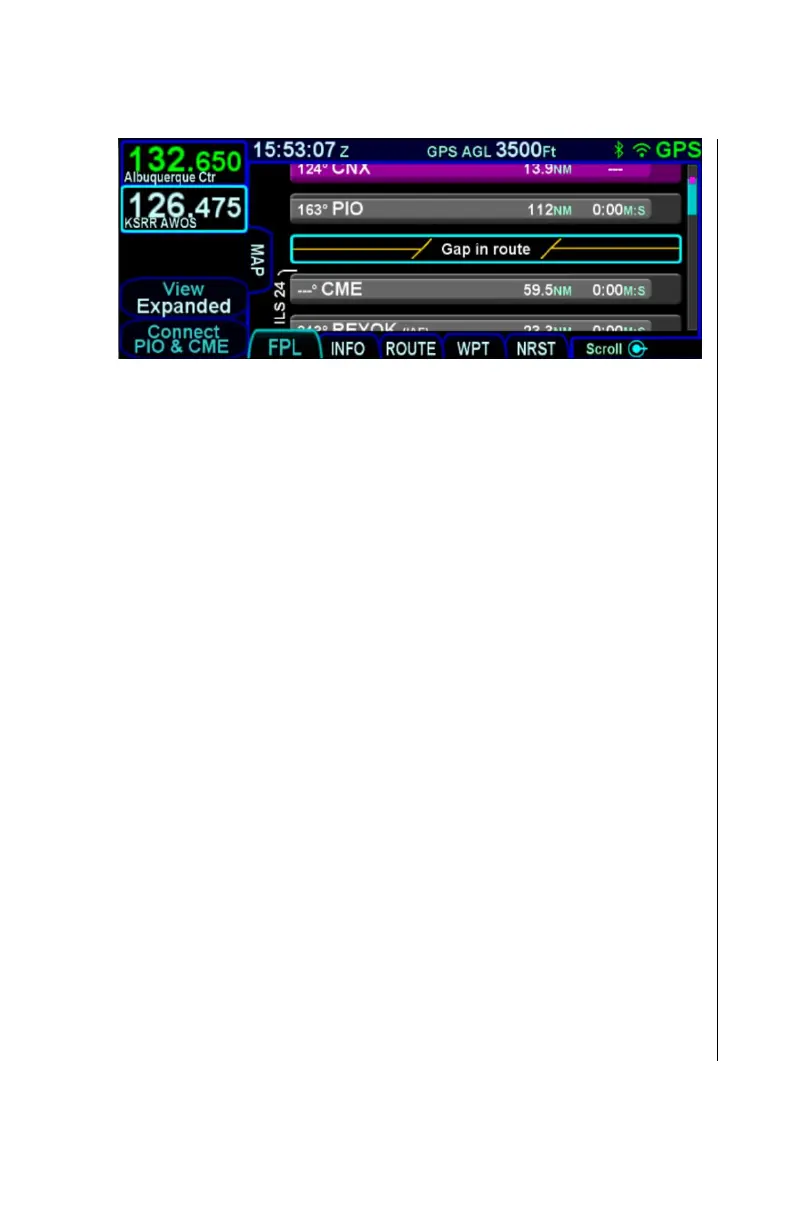
Connecting Gap in Route
There are, however, other conditions which will cause "Gap In
Route" discontinuities. If a route modification results in two
consecutive waypoints with the same identifier, but the two
waypoints have incompatible altitude constraints, then a gap will
be inserted. In this case, one of the two altitude constraints must
be removed. At that point, the FMS will remove the gap. In some
cases, the two waypoints with the same identifier will be
combined, leaving a single instance in the flight plan. However,
at the start of an arrival or an approach, the FMS will not combine
the two waypoints. This allows flexibility in flight planning
because additional legs can then be inserted prior to the
arrival/approach if necessary. If no other waypoints are inserted
and the aircraft arrives at the common waypoint (with the gap
removed), the FMS will recognize that the two waypoints are the
same and sequence both of them, thus activating the subsequent
leg.
Vectors To Final
A Vectors To Final (VTF) discontinuity always precedes an
approach that has been selected with the "Vectors" transition and
cannot be removed. See page 2-32 for further discussion of
vectors to final operation.
Visual Approach
A Visual Approach discontinuity always precedes a visual
approach and cannot be removed. See page 2-36 for further
discussion of visual approaches.


 To Next Page